

News
An agreement to purchase enriched uranium for nuclear reactors could fuel long-term job growth in Pike County
By: David Forster
Posted on:
PIKETON, Ohio (WOUB) — A company enriching uranium in Pike County announced Thursday it has a potential new customer, which could lead to significant expansion and job growth in the area.
But it comes with a caveat.
Three years ago, Centrus Energy began enriching uranium on the site of a former uranium enrichment plant south of Piketon.
Centrus is producing the enriched uranium under a contract with the federal government. The government doesn’t have much use for it, so much of it is being stored on site.
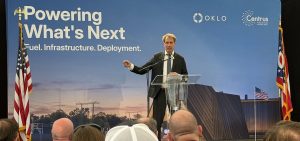
Oklo’s plants would use a new reactor technology that needs the kind of enriched uranium Centrus is producing.
Thursday’s announcement was that Oklo has signed a letter of intent to purchase uranium from Centrus to fuel its power plants for several years.
No contract has been signed yet. But this preliminary agreement provides both companies with some assurances: for Centrus, that it can move to expand its enrichment operations knowing there’s a customer for its product; and for Oklo, knowing it has a reliable source of fuel for its plants.
Also, Facebook parent company Meta plans to buy the power Oklo produces for its data center campuses in Ohio and has made a substantial financial commitment to help move the project along.
All of this could create more than 1,000 construction jobs and hundreds of ongoing operational jobs in Pike County.
However, it is contingent on Oklo getting a license from the U.S. Nuclear Regulatory Commission approving the new reactor technology and the construction of plants using it.
Oklo plans to build its first next-generation nuclear power plant in Idaho. It submitted a license application for that plant in 2020 and is still working with the commission on getting approval.
Oklo has not yet submitted license applications for the plants it’s planning for Pike County, but if all goes well, the company hopes to begin producing power there by 2030.
Oklo CEO Jacob DeWitte noted the demand for power, especially with the rapid build out of data centers around the nation, is outstripping supply.
“We haven’t been building power plants in this country,” he said. “Now we are starting to, and the most important thing for building new nuclear ultimately is going to be centered around fuel. And having surety in that fuel supply chain, having American fuel produced here so close by, is critical to actually getting those plants built.”
Centrus CEO Amir Vexler also noted the synergy created by having uranium producers and consumers next door to each other.
“The fact that you’re able to co-locate fuel manufacturing and power generation on the same site, it really is somewhat unprecedented,” he said. “I think it introduces incredible efficiencies in terms of transportation, in terms of storage of fuel, but probably most importantly around sharing of really capable resources.”
The U.S. was a global leader in uranium enrichment and nuclear power technology. That hasn’t been the case for many years.
The former Portsmouth Gaseous Diffusion Plant in Pike County, where Centrus is now located and Oklo plans to build, was once one of the centers of the nation’s nuclear prowess.
The plant began operations in the early 1950s at the onset of the Cold War, enriching uranium for military weapons and later for commercial power plants.
That enrichment process ended in 2001 and 10 years later a massive, multibillion dollar operation began, and continues to this day, to clean up the site, which was contaminated with radioactive and other toxic materials.
When Centrus fired up its first array of centrifuges three years ago, it marked the first launch of a uranium enrichment plant in the United States in almost 70 years.
DeWitte said actions taken by the Biden and Trump administrations to streamline the nuclear regulatory process should help in getting the needed licenses for the new reactors that will use this fuel.
“It maintains the exact same safety standards, but it allows it to work more efficiently by getting the bureaucratic processes out of the way so the regulators can actually focus on the technical things that matter,” he said. “And what we’re seeing is already significant time savings, where those licensing timelines are shrinking down from over two years to now under 18 months.”