

News
Rising home prices in Athens County drive another big bump in property taxes. New laws may provide some relief
By: David Forster
Posted on:
ATHENS, Ohio (WOUB) — Athens County homeowners should have received a letter by now informing them what the auditor believes their house is worth.
The upshot: For most homes, the value has gone up since the last reappraisal three years ago — in many cases by tens of thousands of dollars.
That’s great news for homeowners looking to sell soon or cash out some equity.
For everyone else, it mostly just means higher property taxes, putting an additional strain on those with already tight budgets. But they can take some consolation in this: It could have been worse, much worse in some cases.
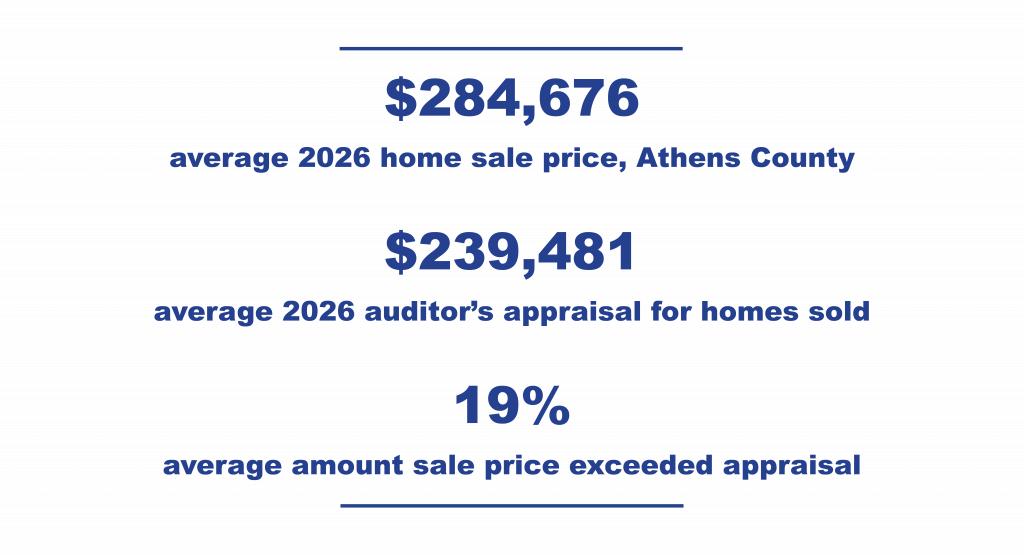
Reappraisals, which happen every three years, are supposed to reflect the actual market value of a home. But the new 2026 appraisals on the whole are below, and in many cases well below, what homes are selling for.
This means that even with the increases, most homeowners are still going to be paying less in property taxes than they should be. It also means that unless home prices start dropping in the next couple of years, homeowners will see another big bump in their property taxes at the next reappraisal in three years — although some new laws could have a moderating effect on just how big that bump is.
With home prices in the county rising so rapidly over the past several years, it’s hard for the auditor to keep up. Also, the timeline for the reappraisal process means the auditor is often lagging behind market trends.
“We’re a day late and a dollar short. I know we are,” said Athens County Auditor Jill Davidson.
Davidson and other county auditors were using home sales from two or three years ago to determine the 2026 reappraisals. It’s just the nature of the process and the deadlines set by the state.
Also, the auditor’s office isn’t sending its appraisers into people’s homes, so they’re basing their value estimates on what they can see from the outside. They may not be aware of renovations inside the home that could substantially increase market value. And as Athens real estate broker Ally Rapp Lee noted, homeowners have no incentive to tell the auditor about these improvements only to see their taxes go up even more.
“Why would you share that information?” she said.
Davidson said she would rather her appraisals come in a little under market value anyway.
“We have a very volatile economy,” she said, “and I don’t want to move everybody’s value up (to full market value) just to have it bottom out, and it takes me how long to catch up, three to six years. So I want to be as close as I can with a … margin of caution.”
That said, homeowners who believe their 2026 reappraisal from the auditor is still too high can challenge it. But a word of caution from Davidson: This could backfire.
Davidson said she’s had several homeowners challenge their reappraisal even though they paid more for their house than the appraised value — meaning the reappraisal should have been even higher, not lower.
“Do you understand that I’m going to go to your sale value if you continue this?” Davidson said she cautions. She encourages these homeowners to let it go and take the win. “Have a nice day.”
Median home price way out of reach for average wage earners
To get a better picture of the Athens County housing market, WOUB analyzed sales data from the start of the year through the end of August. The analysis looked only at single-family homes, meaning no condos or apartments and also no mobile homes. And it only included homes listed for sale on the open market, meaning no sales among family members and other deals that do not reflect true market value.
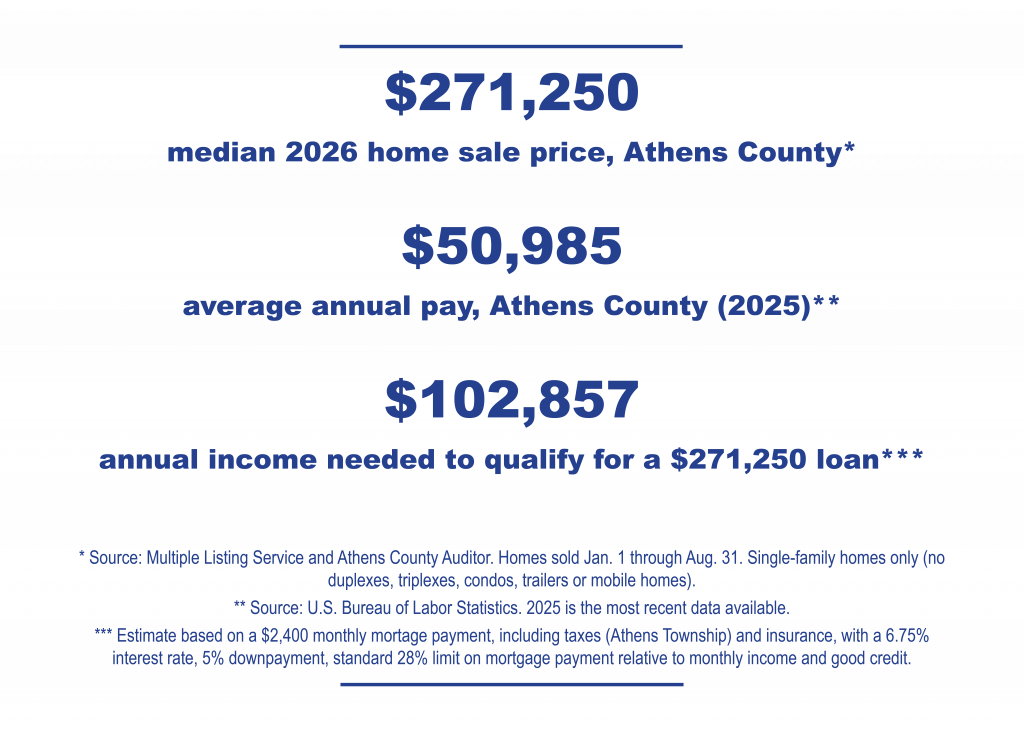
This resulted in a list of 170 homes sold. The median sale price was $271,250. For homes in the Athens school district, the median was $297,000. On average, homes in Athens County sold for 19 percent more than the new 2026 appraised value from the auditor.
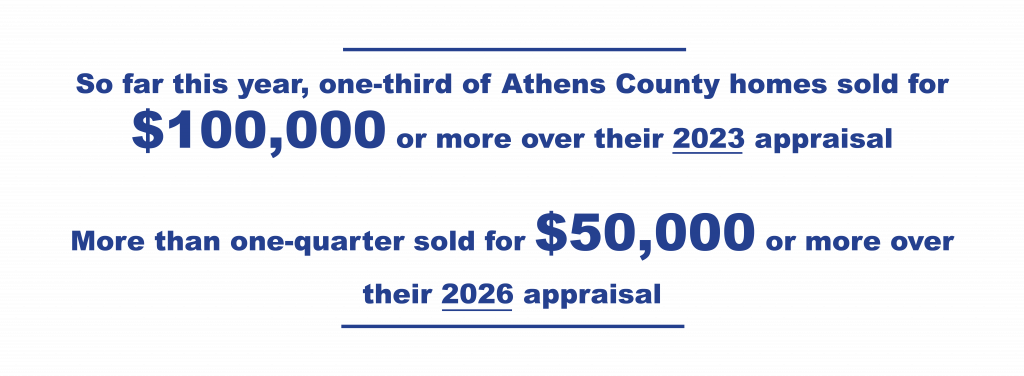
But perhaps the most revealing detail is that nearly a third of these homes sold for more than $100,000 over their 2023 appraised value. This is a reflection of both how much prices have risen over the past few years and also how much the auditor’s appraisals are lagging actual value in a hot market.
Rapp Lee, a co-owner of The Athens Real Estate Co., said Athens, like so much of the country, remains a strong seller’s market.
“There haven’t been as many homes coming up for sale to keep up with demand,” she said, which drives up prices. The homes that are listed often get multiple offers and sell quickly.
Rising prices are leaving more and more potential buyers on the sidelines. “I have buyers who have been looking for a while,” Rapp Lee said. “Prices have been going up, so buyers whose wages haven’t risen, who were looking a year ago or two years ago for that $200,000 house on the east side now can’t buy it.”
A home listed for $200,000 on Athens’ east side would indeed be a rarity in today’s market, where even modest homes in that neighborhood are selling for over $300,000.
Lenders may be reluctant to make a home loan to borrowers who would be spending more than 28 percent or so of their gross monthly income on the total mortgage payment, including taxes and insurance.
According to data from the U.S. Bureau of Labor Statistics, the average annual pay in Athens County in 2025 was $50,985. This income puts the $271,250 median priced home in Athens County way out of reach. Even a couple who are each earning this amount might struggle to qualify, depending on how big a downpayment they can make, their credit rating and other debts.
The higher property taxes that come with higher home values are also affecting the calculus for some potential buyers.
“I have had two different people this calendar year start to look at a house and then say, ‘Wow, these taxes are actually really high. When I calculate that in, I need to go in a lower price point. I can’t buy that house,’” Rapp Lee said. “That’s unfortunate to hear because taxes don’t ever go down. So taxes will be an additional burden on our buyers.”
A primer on how property taxes are calculated
The higher property taxes that come with the new 2026 reappraisals will kick in starting next year. For those who just want to know how much more they’ll be paying, that number isn’t available yet.
But it’s important to understand the first step in the calculation, which is that property taxes are based on 35 percent of a home’s appraised value, not the full amount.
For example: If a home is appraised at $300,000, only $105,000 of that is subject to tax. That $105,000 is multiplied by the tax rate, then various credits and reductions are applied to determine the final tax bill.
The tax rate itself is a product of levies, which voters pass to fund schools, police and fire departments, emergency medical services, roads, bridges, sewers and other infrastructure, park and cemetery maintenance, and other things.
Government bodies can also adopt a certain amount of levies without going to voters for approval.
Levies are usually presented in the form of millage. One mill is a $1 tax for each $1,000 of taxable value. Here’s how the math works:
Let’s say there’s a 3-mill levy for police services. For that $300,000 home, the $105,000 in taxable value is divided by $1,000. The result is $105, which is then multiplied by 3. So that’s $315 in taxes each year for this levy.
It seems pretty straightforward, but like so many things involving taxes, the real picture is more complicated. And as state lawmakers attempt to provide some relief in response to public frustration over the rapid rise in property taxes in recent years, the tax landscape is about to shift even more.
For starters, some levies change over time. This means a 3-mill levy passed years ago may not be 3 mills today. It may be quite a bit less.
Here’s why: Because levies are tied to property values, as values rise, so do the taxes collected under a levy. If that $300,000 home rises to $350,000 in value, the 3-mill levy now means $368 a year in taxes.
An argument can be made that when voters pass a levy, they’re agreeing to pay a certain amount based on current property values. That is, they’re not signing up for unlimited growth in this tax as home values rise.
This argument persuaded the Legislature to pass a law in the mid 1970s that reduces the millage of certain levies as property values rise so that property owners continue to pay about the same amount in taxes as they did when the levy was approved.
But lawmakers also set a limit on just how far levies to fund school operations could fall. This is known as the 20-mill floor.
It works like this: Say in a given school district voters over the years have passed 45 mills worth of levies that are still active. Over time, as property values rise, the millage of those levies keep being reduced. But if the combined total of those levies eventually drops below 20 mills, the district will continue to collect 20 mills.
And from that point on, no matter how low the levies would otherwise continue to drop by applying the reductions, the total will always be bumped up to 20 mills.
School districts like this because it provides them with some funding certainty — a guaranteed amount of millage no matter how much property values rise once the floor is reached. Also, they don’t have to keep going back to voters with more levies — and no guarantee they will pass — which they would have to do if the millage could just keep dropping with no floor.
New laws could provide some relief to property taxes
However, late last year state lawmakers made adjustments to the 20-mill floor in an effort to provide taxpayers with some relief.
One of these changes adds another category of school levies to those that count toward the 20-mill floor.
This doesn’t mean property taxes are going to go down, auditor Davidson said, but it does mean they may not go up as much as they would have otherwise.
Here’s an example: A school district has several levies that count toward the 20-mill floor calculation and total 40 mills as passed. Because of reductions over the years as property values rose, the total millage for those levies is now 18. But the school district continues to collect 20 mills because of the floor.
Let’s say that same district also has a 5-mill levy that is not among the levies subject to annual reductions as property values rise, so it’s still at 5 mills, and it also doesn’t count toward the 20-mill floor.
So, the district is collecting 20 mills for the 18 mills worth of levies that effectively get bumped up to 20 because of the floor. It’s also collecting 5 mills under the other levy, for a total of 25 mills.
But if that 5-mill levy were to now count toward the 20–mill floor calculation, the total instead would be 23 mills — the 18 combined mills of the levies subject to annual reductions, plus the 5-mill levy.
Because this puts the total over 20 mills, there is no bump, and the district will collect 23 mills in tax revenue instead of the 25. This means property owners will be paying 2 mills less in taxes than they otherwise would have.
Again, this doesn’t mean property taxes will go down, that people will be paying less than they did before. As long as property values keep going up, taxes will too. Keep in mind that not all levies are subject to reductions as property values rise. Also, once a school district reaches the 20-mill floor, the reductions no longer apply, so taxes from that point on will increase along with property values.

One is another change to the 20-mill floor. Under this change, if the bump up to 20 mills for a given school district results in an increase in property taxes that is higher than inflation in a given year, taxpayers will get a credit equal to the excess.
This only applies to districts that are at the 20-mill floor. For example, say the combined total of a school district’s operating levies are now at 16 mills because of reductions over the years in response to rising property values. The district would get a 4-mill bump up to 20 mills. But now, if this bump results in a tax increase that is more than inflation (calculated using national data) taxpayers will be credited the difference. This means school districts will get something less than 20 mills worth of taxes.
“So the 20-mill floor is no longer going to be a 20-mill floor,” Davidson said. “They’re going to restrict the growth to the inflationary cap.”
This will make it more challenging for schools to do their required five-year financial forecasts, Davidson noted, because they won’t know what that inflationary cap is going to be each year until the government calculates it.
Lawmakers are also applying an inflation cap to another set of property taxes known as inside millage. This functions as a levy, except it doesn’t go to voters for approval. Instead, government bodies such as school districts, city and village councils and county commissioners can approve these taxes on their own, up to 10 mills combined.
Inside millage is not subject to reductions, which means as property appraisals rise so does the tax collected. Under the new law, this tax growth will be limited to an inflation-based cap. So, depending on the cap in a given year, the increase in taxes could be less than it would have been without the cap.
Auditors can remove outliers from the reappraisal sample
Another new law makes a change to the process for reappraising property values. The way the process has worked is the state used sales data to calculate how much property values had increased in each taxing district since the last reappraisal. Based on this, the state then told county auditors how much they needed to raise appraisals.
Davidson said this “aggravated me to no end.”
“The county knows a hell of a lot better what’s happening with our values than the state does,” she said. “So stop coming to us and telling us these are the sales that you have to use.”
Under the change, auditors can now use what they believe is a representative sample of property sales to determine the increases (or decreases if property values decline, which hasn’t happened much lately).
Davidson says this is significant. For example, say there’s a home that underwent extensive renovations and sold for substantially more than other homes in the neighborhood. If this home is included in the reappraisal sample, it will push up appraised values for homes in that area even though the home is not representative.
County auditors can now remove outliers like this from the reappraisal sample.
Another example would be a small village or a neighborhood in which there are few home sales, maybe just one or two in a given year. This may not be a representative sample for appraising the value of the other homes in the area, and auditors can now exclude these sales if they don’t believe they reflect market value.
Davidson emphasized that while these legislative changes are aimed at providing taxpayers with some relief, this doesn’t mean property taxes are going down but only that they might not rise as fast as they would have otherwise.
“So the phrase to remember: Less than otherwise would have been is not the same as less than last year,” she said. “That’s really important.”