

Culture
Now Playing: The new meta movie proves that the truth is still elusive even when ‘You Can See Everything’
By: Gordon Briggs
Posted on:
Part documentary, part dark comedy, part mystery, and part magic trick, You Can See Everything is a standout work of 2026. I don’t know how many people are familiar with Nathan Fielder and Lance Oppenheim, but the two oddball filmmakers have crafted a unique blend of documentary and fiction to explore the life of convicted fraudster Elizabeth Holmes, but in doing so have touched on how, in our current media environment, the truth itself may be impossible to find.
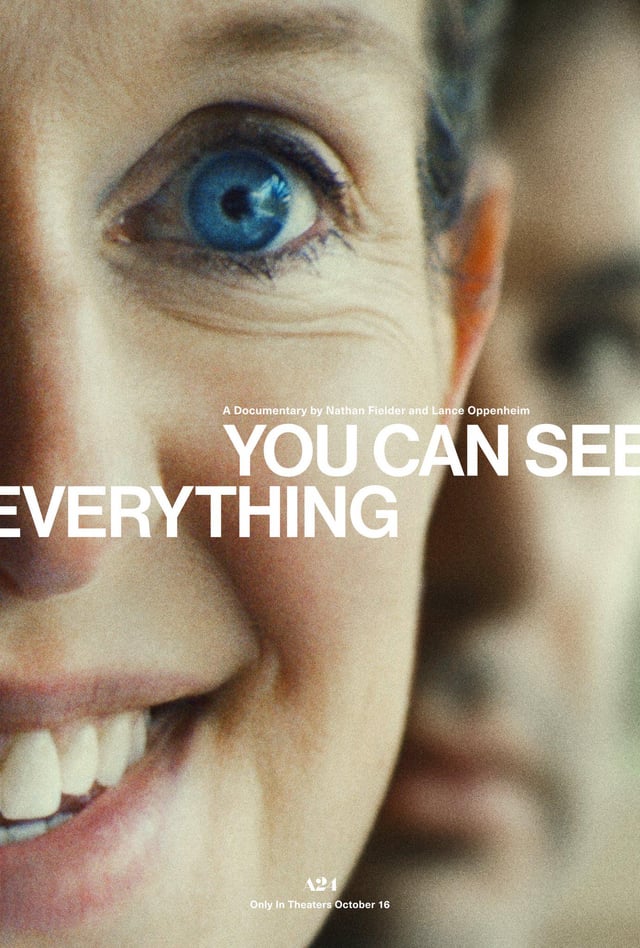
First, the filmmakers are characters within the story. Instead of remaining an invisible, objective observer, Nathan Fielder frequently steps into the frame. He functions as an audience surrogate, explicitly challenging Holmes’ deceptive phrasing and confronting her about her past media. Nathan repeatedly questions whether Elizabeth is genuinely sincere or playing a carefully constructed character. He notes her physical reactions, such as shaking during a hug or wide-eyed eye contact, while wrestling with whether a convicted fraudster is manipulating him.
I don’t want to praise the film simply for its premise. Visually, I like how the camera gets up close and tight on its subjects. The camera frequently pushes in to capture micro-expressions and eye wiggles. Although the film can be classified as a documentary, the precise staging, deliberate lighting, and controlled domestic settings feel as carefully constructed as a scripted motion picture, further blurring the boundary between genuine reality and calculated performance. In fact, some close-ups of Holmes’ face made me wonder whether she’s a master manipulator or just incredibly naive.
As the story continues and the line between reality and fiction blurs, Fielder uses actors to reenact what the camera doesn’t show, creating fiction within a fiction to reveal “the truth.” This is what I enjoyed about the movie. Unlike other more expensive recent works, You Can See Everything isn’t metatextual to show how clever it is. Rather than operating as a conventional documentary about the disgraced Theranos founder, the film uses its layers to interrogate the documentary medium itself, exploring how reality is constructed, manipulated, and performatively packaged for an audience. It all culminates in a fascinating scene where Holmes’ husband confronts a famous actor in his home, each accusing the other of not being “real”. ★★★★