

News
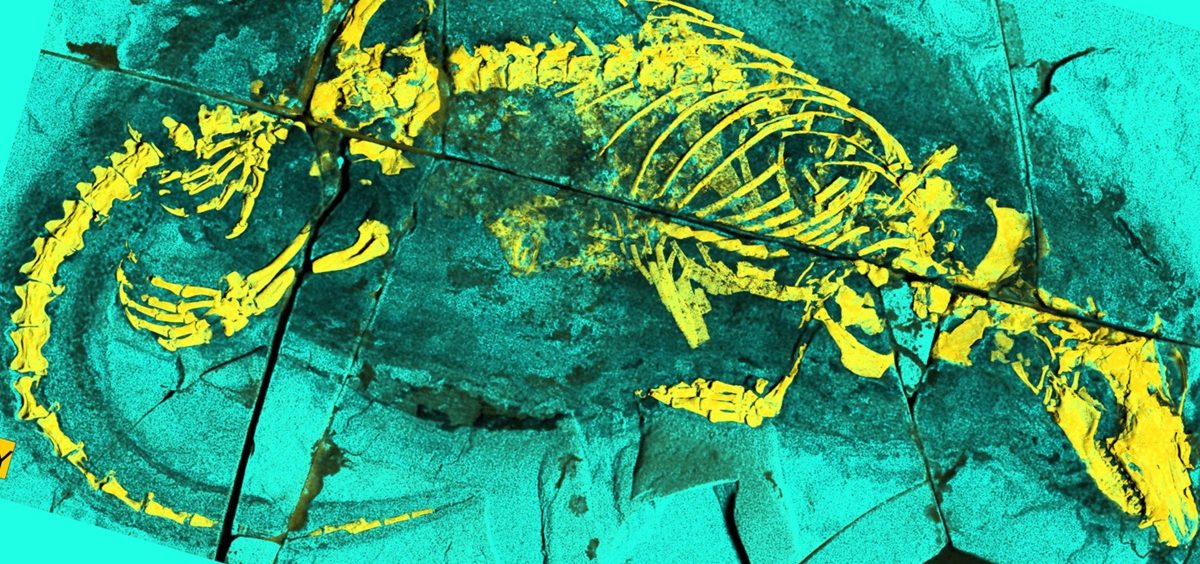
Modern Science: New research on a Megacauda fossil involving an Ohio University professor disrupts previous timeline of mammal evolution
By: David Forster
Posted on:
ATHENS, Ohio (WOUB) —A researcher at Ohio University was part of an international team that uncovered new evidence illuminating the evolutionary origins of one of the defining features of mammals: the ability to suckle and consume milk during infancy.
Peishu Li is an assistant professor of biomedical sciences at the Heritage College of Osteopathic Medicine at Ohio University. The team’s research, recently published in “Nature,” suggests the discovery of a Megacauda fossil shows key anatomical structures required for suckling and swallowing evolved nearly one hundred and sixty five million years ago, long before the appearance of modern mammals.
Li sat down to speak with WOUB’s David Forster for “Modern Science.”
This interview has been edited for brevity and clarity. The first draft of the transcript used for this story was created in Adobe Podcast, which includes an AI transcription tool. WOUB Digital News Editor Aaron Payne then reviewed, corrected and reformatted the transcript before publication.
On the complexity of suckling and swallowing
“Suckling and swallowing for that matter are no easy tasks, even though it’s something that every one of us has done starting from day one of us being born. But it actually requires a very complex sort of interplay between the muscles in your face as well as well as your tongue, as well as these muscle flaps that cover the roof of your mouth to protect your airway all the way down to these in your throat area.
“Every mammal has these interesting circular muscles called constrictors that wrap around your throat, and they’re able to squeeze down your throat to help propel the food down into the esophagus. So these constrictor muscles are actually unique to mammals. No other land dwelling animals have them. We think that they present a very interesting new way of swallowing for mammals.”
How the Megacauda fossil disrupts previous thoughts on the evolutionary timeline of mammals
“The sort of key feature that we honed in on was a pair of bony hooks that sits just behind the roof of the mouth in this animal. These bony hooks, they were thought to only be present in mammals before. We thought that none of the mammal ancestors in the age of dinosaurs had these.

“The moment we found these bony hooks, we’re like, ‘Ah!’ In every living mammal today, this bony hook has this one-to-one correspondence with the soft palate and those constrictor muscles. This animal must have had something very similar to that as well. It must have had the ability to be able to protect its airway when its swallowing and suckling like a mammal.
“It also has these very delicate bones called the hyoid bone that’s in mammals suspending in our throat. Megacauda has these bones as well in a very mammal-like fashion. These bones help anchor the rest of the constrictor muscles along our throat.
“The combination of these bony hooks and the very mammal-like hyoid bones in Megacauda suggests that it’s probably most of the way there in terms of establishing this modern, mammalian-like throat apparatus for suckling.”
On whether this fossil is the oldest with this mammal-like anatomy
“This is definitely among the oldest so far, although hopefully the optimistic side of me thinks that there will be something even older popping up one day, but we don’t know that for sure.”
Next week’s episode of Modern Science will focus on how the Megacauda fossil also changes what we know about semiaquatic creatures.