

News
Previously unmarked underground railroad sites are recognized thanks to a tri-state initiative
By: Amanda Pirani
Posted on:
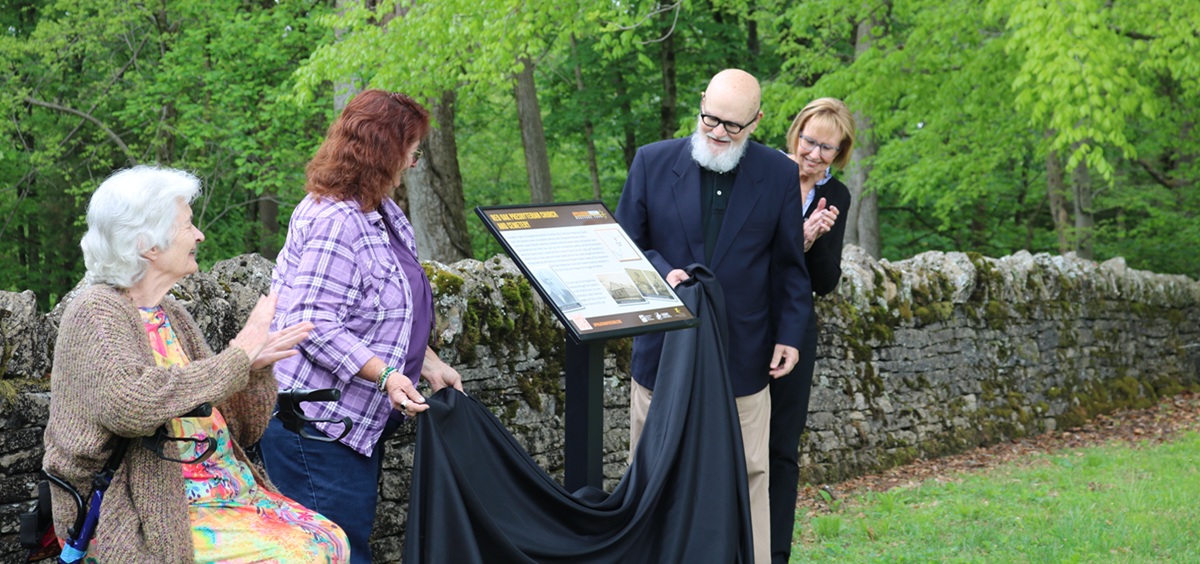
RIPLEY, Ohio (WOUB/Report for America) — Red Oak Presbyterian Church is one of the oldest structures in Brown County, built in 1817.
It’s a small, unassuming stone building tucked behind a graveyard.
But if its walls could talk, they’d tell you about its members, who helped guide and shelter hundreds of people as they escaped slavery.
“They were on a mission, and their mission was the ending of slavery and the freeing of people who were enslaved,” said church historian Rick Bauer.
He’s a descendant of those abolitionists and learned about them through extensive genealogy research.

This month, it was marked as a location on the National Park Service Network to Freedom map.
That’s thanks to the Appalachian Freedom Heritage Tourism Initiative, which works to recognize historical underground railroad sites across Kentucky, Ohio and West Virginia.
Marty Conley, director of the Lawrence County Chamber of Commerce, says prior to the project, there was only one underground railroad location identified in the area.
Now, the initiative is helping share local history that in some cases was unknown to communities.
“It kind of gives you goosebumps, because a lot of this stuff has not really been told or told correctly,” Conley said.
Shawnee State and the Lawrence County chamber are among the 18 organizations involved in the initiative, which received funding from the Appalachian Regional Commission.
The team hopes to see 27 regional sites added to the Park Service’s Network to Freedom. Red Oak is the 18th recognized so far.
Initiative helps unearth local history
The idea to mark the sites came to fruition when a group of Ohio visitors bureau directors were studying tourism data around the John Rankin home in Brown County.
Rankin was a presbyterian abolitionist who is estimated to have housed over 2,000 people escaping slavery.
Conley and a colleague knew there was history beyond the Rankin house and decided to take on a project to explore those stories.
“As a grandfather, this is a project I want my granddaughter and future generations to be able to understand, to hear,” Conley said.

“It’s a reflection, you might say, of the idea that Appalachia is basically inhabited by white people,” he said. “They just don’t associate this part of Ohio or West Virginia or Eastern Kentucky with the underground railroad.”
Feight said verifying a site’s history required locating accounts from freedom seekers that could then be corroborated by other primary sources or evidence like census records — but tracking those down is no easy task.
“The activity was illegal, so people didn’t record the activity. Or if they did, they might destroy those documents,” Feight said. “I think there was probably even a stigma to some degree in polite society where it was too radical of a thing for people to be engaged in.”
Records belonging to 19th century historian Wilbur H. Siebert laid much of the groundwork for researchers like Feight. But he said a lot of important stories remained untold.
“There’s a wealth of information in his research files that never made it into his books, and it’s almost like he had a blind spot for the role that women were playing,” he said.
Through their work, Feight and other researchers were able to connect local families to their history and highlight the work of women on the underground railroad.
Kristel Titus, a descendant of Red Oak abolitionists, said that for her, it’s an opportunity to remember the values and work of the people that came before.
“It just amazes me just thinking about what the people did in the day to day,” she said. “And how they were able to survive and move through this time in their lives.”
Amanda Pirani is WOUB’s Report for America Journalist covering Economic Livelihood. For more information about Report for America, you can click here.