

Culture
Funk legend Bootsy Collins talks James Brown, P-Funk, Sly Stone works amid Palefest & ‘Metal Health’
By: Ian Saint
Posted on:
MIDDLETOWN, Ohio (WOUB) — Parliament and Funkadelic are associated with intergalactic imagery, and star-pupiled bassist Bootsy Collins was one of their “Mothership” captains. But Bootsy’s earthly origins and current orbit are both in Ohio.
Today, Collins drops new album Metal Health and commences the two-day Palefest at Middletown’s Land Of Illusion Adventure Park (8762 Thomas Rd.)
Collins’ wife Patti explained their unique festival partnership to WOUB: “Palefest is introducing Bootzilla’s Buckethead Land of Illusions. There’s going to be ‘Easter eggs’ all over this beautiful waterpark — you’ll see Bootsy and Buckethead in a whole ‘nother way. Our headliner is Barbie T, the female Buckethead, flying from Europe. We’ve got Alien8 — who’s on the Metal Health album — from Cincinnati, he plays multiple instruments. Bootsy will do a meet-and-greet, as we release Metal Health with our partner Roc Nation. It’s a daylong party, starting at 10 a.m. The Bootsy and Patti Collins Foundation will embrace kids with our Land Of The Superheroes mission — we’ll give capes to children. We’ll have a gaming truck; Bootsy has a game on Epic’s Fortnite map for the children to play.”
Bootsy Collins spoke with WOUB’s Ian Saint. Their conversation, edited for length and clarity, follows.
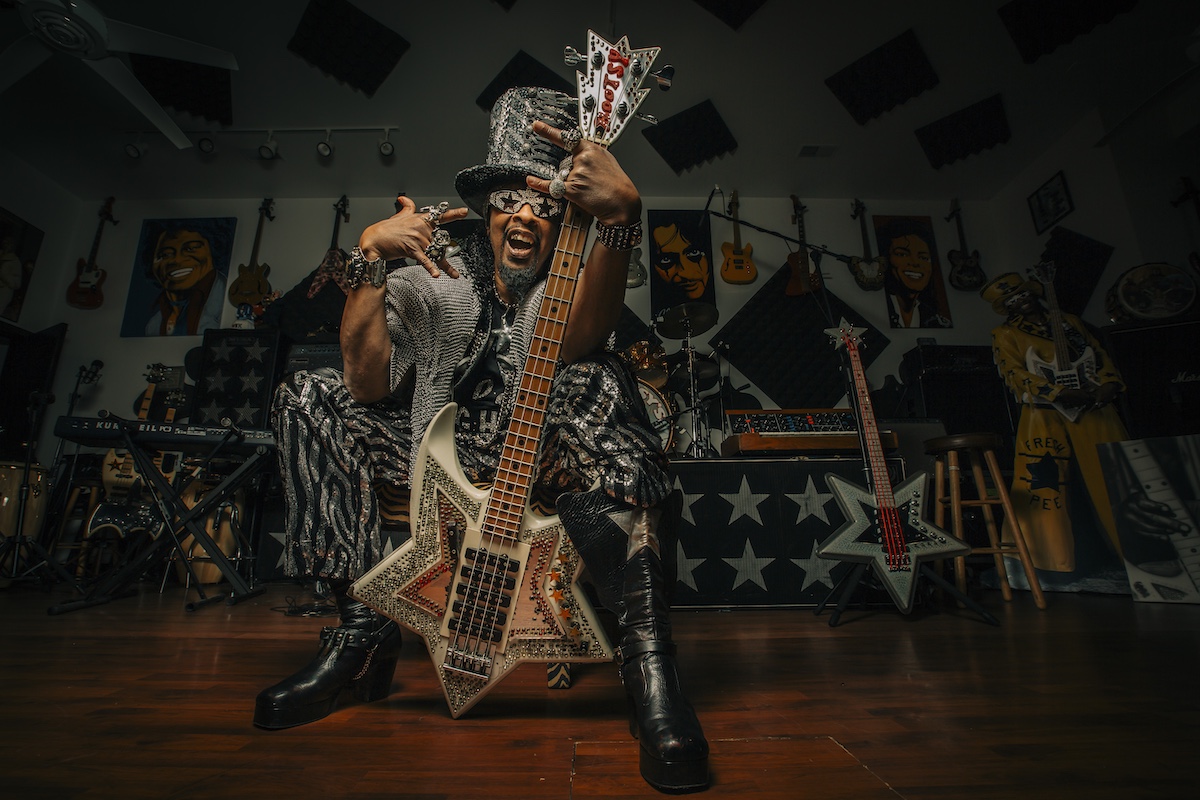
Bootsy Collins: That’s my boy.
Ian Saint: You and your brother Catfish, Kool and his brother Khalis, Ohio Players, Bobby Womack are all from Ohio. What made Ohio such a crucial funk breeding ground?
Bootsy Collins: What was really good about Ohio was lots of people just wanted to be musicians and create together as a band — not just play behind singers. The band era was really blossoming when I was coming up, and it was a positive competition. Everybody wanted to sound tight, be groovy with people, and have fun.
Ian Saint: The Pacemakers, yours and Catfish’s band, was hired by James Brown to become The J.B.’s when you were only 18. How did that happen?
Bootsy Collins: Charles Spurling, A&R at King Records, came to hear us at a club. He wanted us to do sessions on his records. Once we started with him, word started going around about these young, fresh cats with great energy; so we started recording with Bill Doggett, Hank Ballard, and lots of great people. James Brown started getting hip, like, “Let’s see what them boys got.” His production took us out on the road with Marva Whitney and Hank Ballard, before we got with James.
Ian Saint: It’s remarkable to imagine teenage Bootsy revitalizing James’ career with funky stompers like “Sex Machine.”
Bootsy Collins: We were just excited to be in the same room with James Brown. People ask if he ever paid us for the sessions. Pay us? We thought we had to pay him! He was the Godfather of Soul — just to be in a room with him, vibing, we wouldn’t think about money. We was hitchhiking, doing anything we could just to play in rathole clubs. We got paid afterwards; being with James Brown allowed us to play coliseums and stadiums.
Ian Saint: Moving on to Parliament-Funkadelic. What do you remember about recording “Flashlight,” one of P-Funk’s biggest hits — with you playing drums, instead of bass?
Bootsy Collins: We were all in (Detroit’s) United Sound studio, we called the P-Funk Lab. We were in the studio all the time — we lived across the street — so “Flashlight” was just another day at the office, having a good time whether the record came out or not. We didn’t know whether people would like it, because it wasn’t your average formula — we was just doing what we felt.
Ian Saint: You and Catfish were locked-in on that “Flashlight” intro.
Bootsy Collins: Yeah, that’s what we’d call “a hit” with James Brown & The J.B.’s: “Let’s start it off with some hits,” then everybody jumped in. We were developing our own style as we grew in the studio, and (P-Funk frontman) George Clinton allowed us to do everything we wanted. He’d come up with most of his lyrics just hollering on the microphone while we put the song together. It was funny, and we had no idea “Flashlight” would be a hit.
Ian Saint: P-Funk were inducted at the Rock Hall’s very first ceremony in Cleveland, alongside icons like Joni Mitchell, CSN, Bee Gees, Buffalo Springfield, Jackson 5 — even Michael Jackson attended.
Bootsy Collins: And Prince inducted us. It was insane. “Wow, we’re getting in the Rock & Roll Hall of Fame. Who would’ve thought?” That was an incredible night.
Ian Saint: How was having that honor staged in your home state? I think Cleveland’s inductions are even more fun than NYC and LA’s.
Bootsy Collins: Yeah, such a great vibe. People stood up, grooving and having a good time — that’s usually what people do in Ohio, they just need a place to lose it after working hard all week long. You hear Parliament-Funkadelic, it’s time to let loose. “Give up the funk.”
Ian Saint: Is it true that you recorded with your hero, Sly Stone, in Detroit in the early ‘80s?
Bootsy Collins: Yeah, we recorded over a couple years. We had a great time — Sly played drums, too. You know, I’ve got stuff we recorded that never came out.
Ian Saint: That’d be amazing to hear, because then Sly vanished for a couple decades.
Bootsy Collins: He was always telling me about how deep the road was, when I’m still having fun and he wasn’t having fun in the music business. He didn’t want to do it anymore, really. You’re always trying to outdo yourself, come up with bigger hits; people want to hear the same songs, “they don’t want me to change.” That gets in the artist’s way, and makes them back off — Sly, Prince… We just lost my friend, D’Angelo — we’d talk all night. I knew what he was going through, because I go through the same thing. But by me understanding it, I think that’s why I’m still hanging around.
Ian Saint: That speaks to the themes of your new album, Metal Health.
Bootsy Collins: It’s something we ain’t really designed to know, because we’re just human beings. I think the connection with The One really helped me keep my focus and mind. All of us go through that mental thing, whether we admit it or not. I figure if I start saying something about it, maybe that’ll make it easier for people to address.
Ian Saint: Metal Health premieres during Palefest. I love that you’re offering activities for entire families to enjoy.
Bootsy Collins: Yeah, we need more of that, because families are getting separated and scared to talk to each other. At Palefest, (we’re striving for) families coming together and having fun again.
Ian Saint: Congratulations on Bootzilla Records signing your first artist, DAVIE. What’s your label’s mission?
Bootsy Collins: The whole thing is about talent, and helping you develop it. Back in the day, record companies usually had no understanding about the music and what artists go through. I’ve been through that; I learned how to let that mental anguish run down my back. I want to be a mentor to these young artists.