

Culture
Bikini Kill’s Kathleen Hanna talks Daisy Chain Fields and finding hope amidst dark times with WOUB
By: Nicholas Kobe
Posted on:
CLEVELAND, Ohio (WOUB) – In the male-dominated rock landscape of the late ’80s and early ’90s, Bikini Kill cut through the scene like a knife. In true punk fashion, the band was DIY, abrasive, and deeply political. That approach made Bikini Kill a target for attacks in the media and in person, but its focus on feminism also put it at the forefront of the riot grrrl movement, which helped carve out a prominent and unique space for women in punk rock.
Bikini Kill released two albums, Pussy Whipped and Reject All American, in 1993 and 1996, respectively, alongside EPs and demos. The band split up after Reject All American and fully reunited in 2019, consistently touring since.
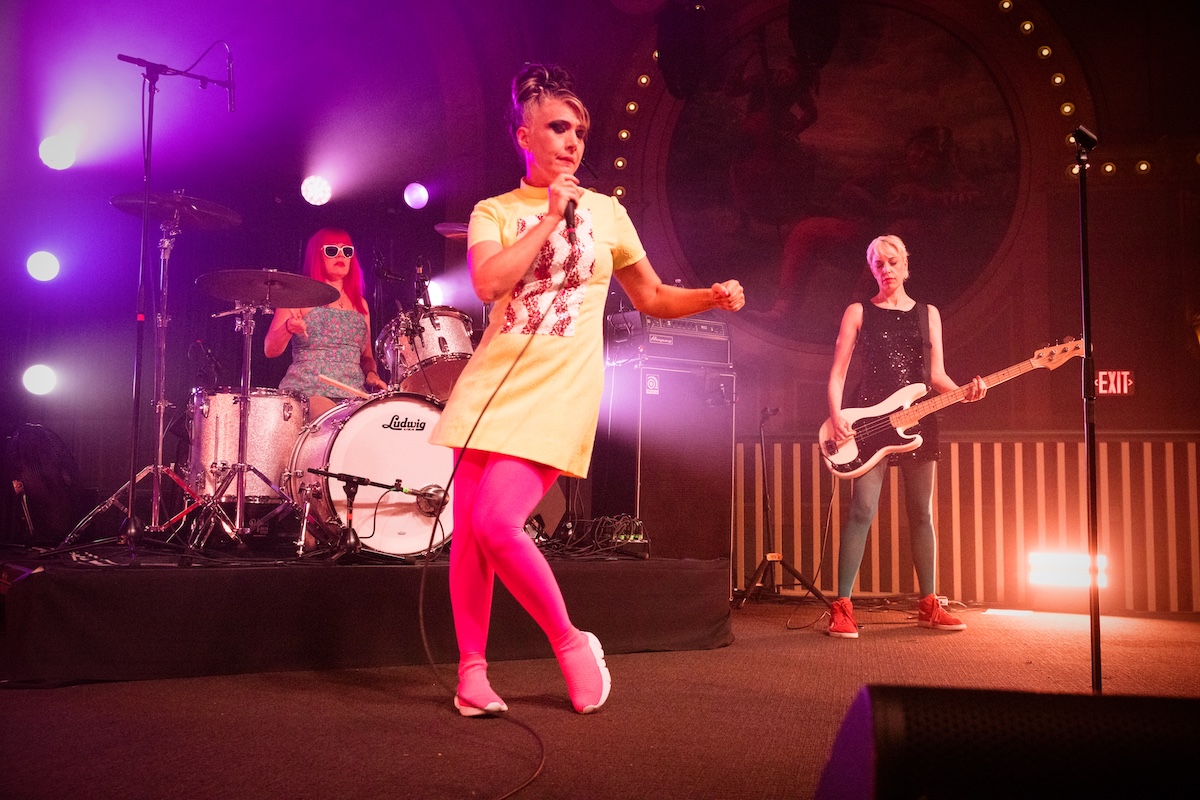
Ahead of its fall 2026 tour, Bikini Kill brought its hardcore, intense sound to the inaugural Daisy Chain Fields festival, a charity festival organized by pop superstar — and Bikini Kill fan — Olivia Rodrigo to raise money for organizations benefiting women around the globe.
Nicholas Kobe: How would you describe Bikini Kill in one sentence?
Kathleen Hanna: I guess I would say a feminist punk band.
Nicholas Kobe: I mean, that’s pretty much the most straightforward way to put it. Recently, the band played at Daisy Chain Fields Festival. How was that experience compared to some of the other festivals and shows that Bikini Kill has played?
Kathleen Hanna: It was like years ahead of any festival we’ve ever played. I mean, the thing that was really wild was that Olivia [Rodrigo] and her team set this up; I think they had like five or six months to do this, which most festivals are like planning two years out. They had a tent with all the leaders of the nonprofits that were benefiting, because it was a concert that everybody played for free to raise money for nonprofits helping with reproductive rights and women’s health care. They had a tent set up where the leaders of each nonprofit were, and they had book bags you could go into with a flower on them; you would talk to the person and then get a pin to put on the flower. Everything was very interactive. Besides it being way too hot, which was beyond their control, they did an amazing, amazing job. I mean, having so many women work backstage, sound people it was like the whole thing; they hired women. They had women making the products; they had every little thing about it really well thought out, well designed, and curated.
I really appreciated that. I think that the spirit of the event was so positive because everybody knew we were raising money for these really important causes. I got to see my friend Santigold; I haven’t seen her in a really long time, and I got to hang out backstage. It was just a really good feeling. Festivals can be really fun, but a lot of times, it’s another show. And this felt like something really, really special that we were really lucky to be involved in.
Usually at festivals, we sort of have our little trailer and everyone else is separate. You really have to push to be able to go meet somebody. Like we met Charlyn Marshall from Cat Power at a festival, and that was really fun. But we remember that because it was remarkable that we got to meet this other performer who we really loved, and we had such a great time with her.
Nicholas Kobe: With the audience at Daisy Chain, considering the diversity in terms of genre that was at that festival, what was the reaction like from the crowd to your really intense music?
Kathleen Hanna: I mean, they seemed to love it. It was packed at our stage, and there were people singing along to the lyrics. And I was really I wasn’t gonna talk very much because our set was very short, but then I was like, “There are young people who I probably would never meet in real life. Like, I should say some stuff I wanna say.” And when I did, people gave me thumbs up and thumbs down and really reacted to what I was saying. I thought that was particularly incredible. The audience was very engaged. It wasn’t a passive audience. Like, yeah, people pulled out their phones.
They knew they were part of a historical moment, but people were, like, watching the show and, like, reacting and dancing. I felt, going in, I was kind of like, okay, us and Die Spitz are kind of like the hard, heavy bands. Luckily, we sound very different. But I was sort of like, “Are we gonna be playing to a pop audience that’s like, what is that?” That was actually really exciting, and it determined how we did our set list. We’re like, “Let’s start with the really weird older, bare-bones punk songs first,” to be like, “Hey y’all, this is what you’re getting into. If you can’t stand this part, you should just go, you know, get some food right now.
Nicholas Kobe: Absolutely. And when it comes to touring with Bikini Kill overall, it’s been a long time since there’s been a new music release. What keeps you and the band interested in touring and still playing this music?
Kathleen Hanna: I think it’s that a lot of the lyrics- I’ve kind of learned that as a singer, you have to be an actor in a certain way because there are certain songs that you write maybe as a character or like as your better self. I would, when I was younger, write them as coming from a more powerful person than I am in my everyday life. I’m like this superhero feminist and like, you know, I can say whatever I want, and I can speak back to power. Whereas maybe in my regular life I couldn’t. Now I am more that person. I don’t have to put on that character.
But then in some songs, the meaning has totally changed. We have a song called “Lil’ Red”, and it was sort of about using femme accouterments like long nails and high heels or whatever as weapons. There’s a line in the song that’s like, “you’re not the victim, though you’d like to make it that way. Pretty girls, I’ll gather around to hear your side of things.” That was a minor line in the song for me earlier; now it’s the whole song. I can’t wait to get to those parts because that’s what the right wing is doing right now in gaslighting us, saying,
“White men are really the real victims.” And, you know, “feminism is destroying the family. And trans people are really the big problem. They’re destroying everything and, we, the powerful, the rich, the people who get the best jobs, the best housing, we’re the ones who are really being oppressed by immigrants and trans people and feminists and what have you.” They see the murder of people of color as self-defense for their whiteness, and they think that they’re the victims. So that’s a different part of the song that I’ve been focusing on when I sing. The song is still about what it was originally about, but it’s also very much about that.
Nicholas Kobe: How does it feel for you and the rest of the band, for so much of the music to still resonate in part, because so much of what you were singing about and the injustices are still around?
Kathleen Hanna: Well, and they’re worse in a lot of ways. We spend a lot of our career playing Rock for Choice shows and playing benefits to keep abortion legal. And we went out on stage in New York for a show a few years back, and we had just been told that Roe v. Wade was struck down. That was a really hard show. What’s really weird is that if you’re in the audience- I mean, a lot of people listening might be in bands and totally understand this, but what people in the audience don’t understand is, like, we sometimes don’t talk about things like that because we’re going to start crying.
And we don’t want to do that in front of an audience. That’s a vulnerable thing that is private. We also want to uplift people and be like, “you know, hey, there’s hope; we can fight back.” But it’s really interesting when something horrible like that happens, and we go out, and people have the expectation, like, “well, they’re Bikini Kill, they’re feminists. They’re immediately going to start talking about what just happened with Roe v. Wade.” It’s like, literally, I couldn’t even talk to the crowd at all that night because I was so f*cking freaked out. And it’s been that way about a hundred different things lately. But yeah, it’s really wild to be singing songs that still make perfect sense.
Now, when you were talking about, like, “how have they changed?” It’s like we have a song called “Don’t Need You,” and it was like we had to sing that song. It’s about not needing male approval, not needing people who are writing reviews of our band to think that we’re good. We’re like, “We’re just gonna do what we do. And if you make fun of us or throw stuff at us, go ahead. We’re just gonna keep doing this.” And it has a different meaning now that we’re older because it’s like, we experience ageism, and people are like, “Why are you still doing this? Like, you know, you should go hide in your treehouse and never come back. So I think, as women who have been making music for 30 years, it’s interesting to be singing “Don’t Need You” as like, “we don’t need you to tell us we’re too old to be here.” Cause we still sound really good. If we sounded like sh*t, I would not be on stage. Like, I will stop.
Nicholas Kobe: Absolutely. So yeah, for you and the rest of the band, how do you kind of manage with, like, having to be the ones that everybody looks to for hope or some answer and to fight back in these dark times?
Kathleen Hanna: I mean, I think it’s such an honor and privilege. You know, I’m looking for the same thing. I’m looking for places of joy. I’ve been watching a lot of freestyle BMX riders on YouTube because seeing women’s bodies in motion makes me really happy. And I listened to it on mute, my own music, and turned down the music on the X Games or whatever it is, and I watch these women flying through the air on bikes and just like doing incredible things. It’s this visceral experience. And it’s like, I want to be, I want my voice to be like a person on a BMX bike that’s popping a wheelie. You know? I don’t really take it as pressure or anything like that. I feel like I’m so lucky that I get to still do what I want to do. And that my voice has held up, and that the band still likes playing together, and we’re still having a good time.
We’re having even a better time than we did when we were getting so much flak in the ’90s, like our shows were dangerous. I would get physically assaulted and have beer spat in my face. And that’s not happening anymore. You know, we have had some violence at some of our shows, but it’s so much less than it was, and I can actually close my eyes and enjoy the music and not have to be looking out for, you know, a wine glass going towards my head. So that’s kind of the big difference. It’s not a victory lap; it’s like healing.
Nicholas Kobe: That’s good that you get that experience with the music now. For you, you’ve also been hosting a podcast for the Rock and Roll Hall of Fame, Music Makes Us, doing interviews and talking with other peers. What’s kind of the most valuable thing you’ve learned from them the more you’ve gotten to meet and talk to people across the industry?
Kathleen Hanna: I think realizing that while all of our experiences are totally different, I’m not alone. I have a community of others there. I focus mainly on singers, partially because singers can tend to be like the lone member of the group. You know, there are three instrumentalists who are all having some of the same issues, and the singer is sort of alone, in this weird way where your body is your instrument. If you get sick, everything is f*cked up. There’s way more pressure on you on tour. And there’s not really a camaraderie amongst singers, like, because usually there’s one opening band, two opening bands.
There’ll be two singers that you can talk to, and it’s before a show, so everyone’s on vocal rest, and no one’s talking. And I’ve really been trying to find out, like, “Well, how can I meet other singers?” How can I ask them, “How do you keep your voice together? How do you write a song?” So really, to me, it’s been feeling like I’m a part of a musical community and hearing other people’s stories about, you know, how they got into music. I mean, I’m talking to people who got into music by making music on TikTok during COVID. That’s such a different experience than being like 19, starting a band in a garage in a small town.
But there are similarities to things that we experience. And it’s interesting to hear how different everything is. Cause I come from a scene where it was like, “here’s the way you do it.” You know what I mean? It’s like you have to start in a garage to be authentic. You don’t have to start in a garage to be authentic. However you start is how you start. Wherever you end up is where you end up.
So it’s been really exciting to be breaking that barrier of “well, I’m an underground artist on independent labels. So I can’t talk to Olivia Rodrigo because she’s like a pop star and like, you know, we’re from two different worlds, and f*ck the f*ck the man and f*ck the corporations.” Like we’re kind of past that. We all need each other, and you know, I feel like the podcast has been a way to sort of say that without saying it.
Nicholas Kobe: Sure, and one more question before we close out here: looking into the future, what are the plans for Bikini Kill kind of headed forward?
Kathleen Hanna: We have one large undisclosed project, which I cannot talk about. We are gonna finish this tour and then talk about what we’re gonna do. I’m not unfortunately allowed to talk about it because it’s not far enough along. It’s more than just, like, a marketing thing of not telling you; I don’t wanna jinx it. I don’t wanna say this thing’s gonna happen, and then it falls through the ground, and it doesn’t happen, and I said it was gonna happen. So it’s like crossing my fingers.