

News

Could data centers boost Appalachian Ohio? Experts say it’s complicated
By: Amanda Pirani
Posted on:
ATHENS, Ohio (WOUB/Report for America) — Last month, what could become the country’s largest data center was announced with great fanfare in Pike County.
Hundreds gathered under a tent filled with lights and booming music to hear what the project will mean for their future. Visions of rapid economic development were met with roaring applause.
In a region state and federal organizations have deemed economically distressed, the promise is enticing.
Pike County Commissioner Tony Montgomery said the area hasn’t seen a major employer since its World War II-era uranium enrichment plant began decommissioning in 2001.
“This is a game changer for us,” he said. “It’ll keep our community alive, keep our community viable.”
In Adams County, data centers could use industrial sites formerly home to the Killen and J.M. Stuart power plants, which closed in 2018. The closures resulted in the loss of over 500 local jobs.
But in a region that’s seen its share of false promises, not everyone is excited about a slew of data center proposals. Some worry massive project announcements won’t pan out.
“There’s still some doubt,” Montgomery said. “We hear from folks, ‘Hey I’m not going to believe anything until something happens.’”
Others fear the opposite. They say the developments feel all too familiar.
“With C8 and Dupont, our injection wells, we’ve seen what big money has done and we’ve been lied to,” said Washington County resident Jennifer Dusky. “We’ve seen this before, so we have our guard up.”
Washington County is one of several in southeast Ohio expecting a data center development.
Dusky grew up in and still lives adjacent to Waterford, where the development site is expected to go. She believes the area is appealing for its affordable land and natural resources.
“Our land is so much cheaper down here,” she said. “It’s nothing for them to offer $50,000 to $80,000 (an acre) … it’s nothing for them to just drop that kind of money to buy our land.”
Experts say Dusky is right. Studies suggest developments are increasingly approaching rural areas because of a proliferation of cheap land, fewer regulatory hurdles and local governments hungry for economic growth.
“People are coming to (southeastern) Ohio because land is inexpensive, and local governments are willing to pay incentives to place those data centers believing there will be jobs associated with them,” said Ball State economics professor Mike Hicks. “And that’s just not the case.”
Ohio and neighboring states compete for data center growth
Data centers might be new to Appalachian Ohio, but the state’s data center industry has been over a decade in the making.
Sales tax breaks on equipment, competitive electric rates and 15-year property tax abatements along with swaths of flat land, have made the state a haven for the developments.
A 2025 Chamber of Commerce report called Ohio a breakout star for its growth in AI infrastructure and said the state could one day “rival or exceed Virginia’s scale.”
Virginia is the nation’s leader in data center infrastructure, with over 500 of the centers.
Ohio ranks 5th, with nearly 200 data centers and 77 more planned.
Nationwide, the industry is expanding at an unprecedented rate as demand for AI infrastructure surges. And geopolitical pressures mean the federal government has its own stake in supporting that growth.
Ohio’s neighbors, like Michigan, Kentucky and West Virginia, have taken notice, passing comparable tax incentives and streamlining development.
Critics, though, describe this competition as a race to the bottom. As each state fights to become the most attractive to data center developments, they give up more and more of the potential financial benefits.
When looking at data center performance, context matters
A report from Ohio’s Chamber of Commerce boasts the industry contributed $11.8 billion to the state’s gross domestic product in 2024 and supported 92,217 jobs.
The context of those numbers, though, is important. When compared to the state’s total 2024 GDP, the data center industry’s output made up about 1.6%.
Sean O’Leary, an economic researcher for left-leaning think tank the Ohio River Valley Institute, said GDP growth isn’t always a useful measure for understanding the economic impacts of a development.
Using the example of the natural gas industry, he pointed to developments in eight southeast Ohio counties.
“We have seen GDP growth skyrocket … but again they are among the poorest and most poorly performing economies in the entire United States,” he said.
When it comes to job creation, data centers in the state directly employed 17,300 permanently as of 2024. That number only reaches closer to the 90,000 in the Chamber’s report when factoring in construction and “indirect and induced employment” using statistical modeling.
Hicks, the Ball State professor, said reports estimating the job output of data centers often come from what’s known as an “input-output” model. The Ohio chamber’s report uses this approach.
“That sort of method is not very reliable in estimating effects,” he said. “What those models can’t capture is: Were those new jobs or were those jobs pulled from somewhere else?”
Long-term benefits in conflict with trade worker boom
The academic research on data centers is limited, in part because the industry and its growth are relatively new. Most economic reports available come from the industry itself or its supporters.
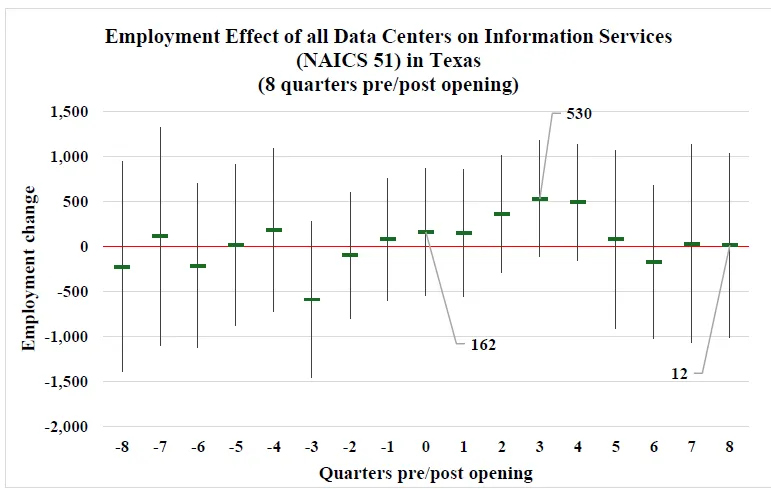
When Hicks looked at the question of job growth using Texas as an example, he did not see significant effects on local labor markets.
“Not just overall, but not even in the sectors where you might anticipate there being a shock, like in construction or data center management, or the professional services that might attend a data center once it’s built,” he said.
Texas ranks second in the country for its number of data centers.
Hicks said data centers don’t have the labor market effects one might expect based on their size.
People aren’t moving from somewhere else to fill jobs at data centers. Instead, they’re hired away from another telecommunications company in the same area.
When Hicks analyzed those shifts in Texas, he didn’t see any net growth in the number of jobs created.
For people hoping data centers will create a bounty of new, high paying roles, it’s not promising.
David Bland, governmental affairs director for a local division of the International Union for Painters and Allied Trades, said the union is looking forward to the projects proposed for southeast Ohio.
“We haven’t really built any big construction projects in my area for a long time,” he said. “The lack of big construction is the lack of work.”
Ashley Labaki, business development liaison for the International Brotherhood of Electrical Workers Local Union 1105, attributed a spike in membership to data center projects in Licking County.
The union went from around 450 in 2020 to over 3,000.
“We are one of the fastest growing IBEW locals in the country right now,” she said.
But a lack of transparency around data center negotiations means communities and unions don’t know if developments will use local workers.
Bland said he’s encountered developments before that promise to hire locally and then import workers from elsewhere. But if he finds out that’s happening in southeast Ohio, he won’t be quiet about it.
“If we can’t build it and we can’t maintain it with our local people, then we don’t really need it,” Bland said.
Can communities benefit from data centers?
Described as the “broom closet” of AI technology, data centers just don’t demand that much manpower.
“The problem with data centers is that they … (are) highly capital intensive, but not at all labor intensive,” economics researcher O’Leary said.
The other reason for this is that the technology data centers are supporting does not have to be near the center itself.
But Hicks said there are some exceptions.
“About a third of the capacity of data centers have what the industry calls latency requirements,” he said. “They need to be close to what they’re doing. And the way to think about that would be medical imaging … applications for national security doing intelligence or de-conflicting airspace for the FAA.”
According to Hicks, data centers with latency requirements will locate themselves in places with a highly educated workforce. He pointed to Loudon County, Virginia, as an example.
“Land’s running $400,000 to $500,000 an acre,” he said. “That’s not an optimal place to build a data center, but it’s an optimal place to build a data center that would take advantage of really specialized human capital.”
Hicks doesn’t see many of the developments in rural Ohio bringing in additional industries in the technology sector.
“No data center being built there is going … to attract a bunch of computer scientists, algorithm writers, PhDs to train the AI,” he said. “That’s just not going to happen. Those jobs will be done by somebody somewhere else.”
The low number of jobs provided by data centers in contrast to their scale of land use can also pose an opportunity cost.
Rick Platt, president of the Heath-Newark-Licking County Port Authority, said he is reluctant to bring a data center development into the area when other developments using the same sites might offer more.
“We’ve got an industrial park that has 2,000 employees, average wage is around $75-80,000 a year. Twenty-five diverse employers in manufacturing,” he said. “Fifteen miles away, the same amount of acreage, the same average pay, but only 70 jobs.”
Platt added that every site for development is unique, and what makes sense for that land in a specific community can vary.
“The sites are like kids. They’re all different from each other,” he said. “They (communities) just need to think about, ‘What could have happened with this site that would have been better if we had held out a little bit longer?’”
Hicks said that the lack of meaningful effects on employment doesn’t mean communities should close the door on data centers.
“That’s an argument against incentivizing them,” he said. “It’s not an argument (for) keeping them out of your community, because there could be fairly good fiscal effects … potentially a very robust local development opportunity for tax revenue.”
He added that there are still a lot of questions that remain for researchers like him. Hicks said the scale of developments like the one in Pike County may have different implications, and that resource effects will also factor into the economic benefits a data center will have.
But he was clear that net positives disappear once a municipality grants tax abatements.
Property tax abatements for data centers divide communities
Those tax breaks have become a flashpoint for communities expecting a data center.
The data center industry wouldn’t be the first to make the ask. But incentives are typically offered because of some other benefit a development might provide, like investment in a blighted area or employment opportunities.
In Scioto County, a Google data center will receive a 75% tax abatement. The county did negotiate a $500,000 annual payment in lieu of taxes agreement.
Some argue that number isn’t high enough in the face of increased electric costs for ratepayers, and uncertainty around impacts on municipal water.
“That doesn’t go very far today,” said Audrey Dotson, who lives near the data center site. “I mean, one fire truck costs a million dollars.”
In Adams County, public records suggest county commissioners will consider a 75% to 100% tax abatement for a proposed data center owned by Amazon.
In Washington County, commissioners may approve a 100% tax abatement for a proposed data center and plan to negotiate a payment in lieu of taxes.
However, Commissioner Eddie Place claimed they would only be responsible for approving 25% of the abatement. The state would approve the rest, he said.
“I want to be very clear that we’re not giving the tax abatement,” he said during a commissioners’ meeting last month.
WOUB could find no evidence in the County Commissioners Association of Ohio handbook or state law that a state agency would approve an individual tax abatement for a particular county.
O’Leary, the economic researcher, argued that if a community cannot negotiate significant tax revenue and shield residents from resource effects, it’s better off without the development.
“I know how painful it is for county commissioners and folks who’ve been struggling literally since the demise of the steel industry 50 years ago to find economic good news,” he said. “I know how hard it is to hear that.”
Amanda Pirani is WOUB’s Report for America Journalist covering Economic Livelihood. For more information about Report for America, you can click here.