

News

Local disability rights advocates weigh the potential impacts of Medicaid cuts
By: Amanda Pirani
Posted on:
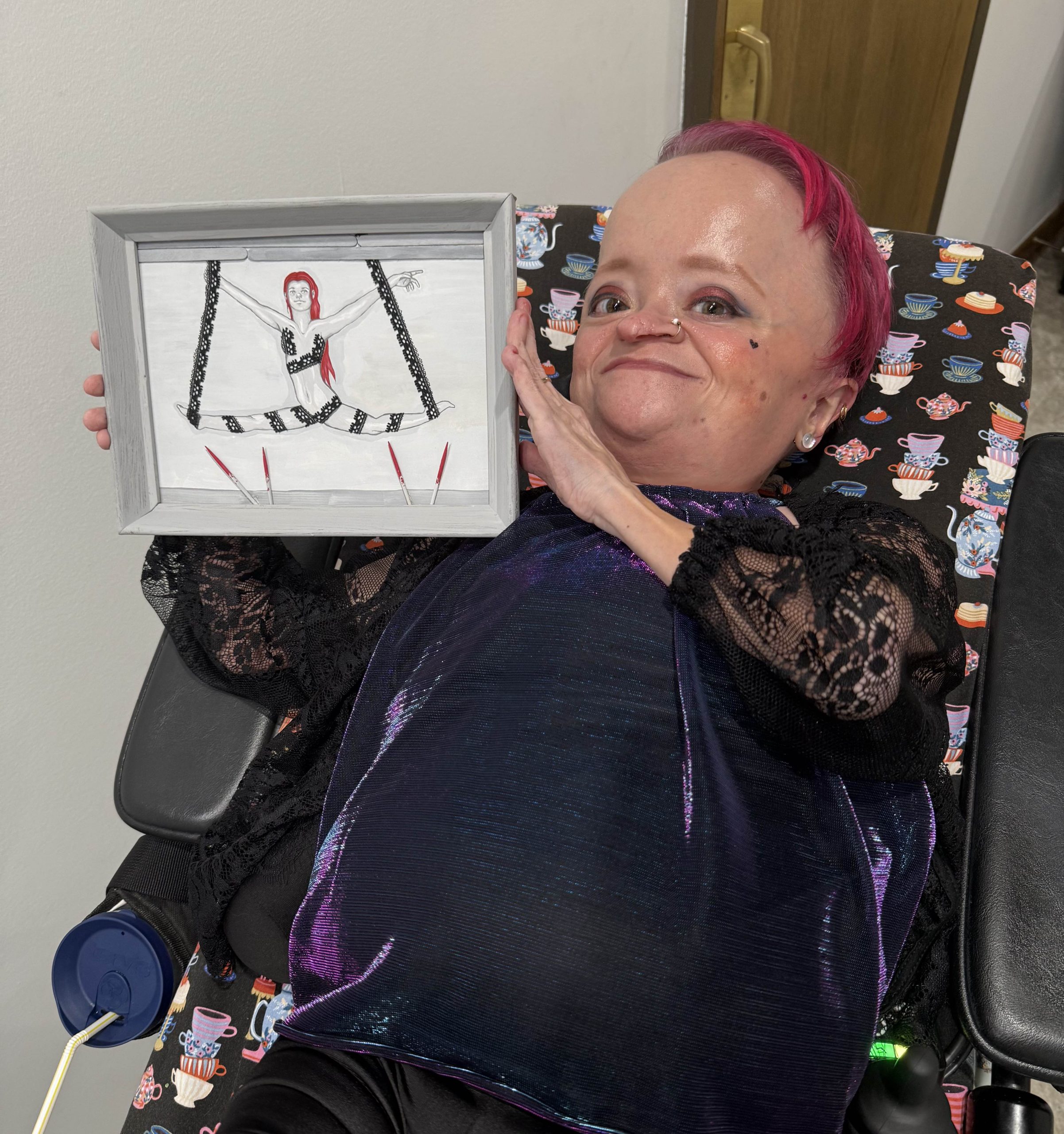
LANCASTER, Ohio (WOUB/Report for America) — Alex Matthews is a 31-year-old graphic designer and wheelchair user who lives in Lancaster. She works part time, and lives independently with the help of home-based health services.
“I use a power wheelchair, and I also spend a lot of time in bed when I’m at home, I am laying down like 100% of the time,” she said. “So I require a lot of care for pretty much everything I do.”
Living on her own wasn’t always possible, according to Matthews. Before insurance covered her full-time care, she relied on her aging parents to help when they arrived home from work.
Right now, a program under Medicaid pays for the care that allows her, and others with disabilities, to live independently — but after federal cuts this summer, she worries those services could be at risk.
“We’re really nervous about even just our hours being reduced, that would be a huge blow to our independence,” she said. “I need 24/7 care, and without that, I would have to go who knows how long between shifts where I would have to fend for myself or … move back with my parents.”
Ohio will lose an estimated 13% of funding from federal Medicaid cuts over the next 10 years as a result of the One Big Beautiful Bill Act, signed by President Trump in July. The law also added work requirements and increased eligibility checks for those covered under Medicaid expansion, which will go into effect in 2027.
Disability rights advocates worry those changes could affect access to critical health care services. Some of the cuts will take the form of changes to how states finance Medicaid, which experts say will shrink their Medicaid budget over time.
That loss has implications for health care providers like hospitals but also threatens optional services covered by Medicaid that people with disabilities rely on, like a home health aide or transportation to medical appointments.
Without that assistance, many people would be left with no choice but institutional care, which states are required to fund.
HCBS allows people with disabilities to live independently
More than one in three people with disabilities relies on Medicaid for their healthcare coverage, according to the Kaiser Family Foundation.
These services are covered under a home and community based services (HCBS) waiver program. There are seven different waiver programs a person might be eligible for in Ohio. Some of them also fund long-term care for older adults.
When community resources and conventional Medicaid coverage cannot provide what someone needs to live safely and independently, they are eligible for care under a waiver.
Davey McNelly directs the Southeast Ohio Center for Independent Living, which helps people with disabilities access resources like assistive technology or housing. He said that as states contend with less funding for Medicaid, he is watching the fate of HCBS waiver programs closely.
“Currently, all states are continuing to opt into it, but there is worry that some states are planning to drop coverage, and in the more hard line … red states, the mechanisms are already in place to do away with HCBS waivers,” McNelly said.
Historically, people with developmental disabilities were often institutionalized or placed in nursing homes. Exposure of mistreatment in those facilities in the 1970s led to advocacy for independent and community living options.
McNelly said he worries the funding cuts could lead states to move backwards, with some already overly relying on institutionalization.
“I probably have helped around 80 people move out of institutional living into community living, and almost every single one of those people has suffered some type of abuse within the system in their life,” he said. “That’s the kind of thing that we’ve done a lot of progress on as a society, and we just really don’t want to get back to that.”
Optional services are historically hit first by cuts
Each county in Ohio has a board of developmental disabilities, which receives a set amount of funding to administer waiver services like nursing, home-delivered meals and personal care.
Stephanie Kendrick, a director with the Athens County Board of Disabilities, said waiver funding is allocated based on an assessment of a person’s needs, eligibility and the county budget.
“We have some people who may only use $5,000 to $20,000 of waiver funding per year,” she said. “But then you may have an individual who has a lot of support needs for 24/7 care … that can range up to, we’re talking close to $500,000 a year.”
The HCBS waiver program earns its name because it’s a program the state seeks a federal waiver to administer. State Medicaid agencies are required to have coverage for nursing home services and home health care, which includes part time nursing services and home health aide services.
Most other home care services are considered optional benefits under Medicaid, along with vision and dental. When state budgets are strained, funding for optional benefits are often reduced or cut altogether.
About half of optional Medicaid spending goes toward HCBS, according to a 2017 study from the Medicaid and CHIP Payment and Access Commission. In the aftermath of the Great Recession, most states made a reduction to either per person spending or the number of individuals served by waiver programs between 2010 and 2012.
County boards of developmental disabilities also receive some funding from local taxes, which means counties with fewer resources would be hit harder by any cuts.
Kendrick said that while it’s hard to predict what will happen, she hasn’t received indication cuts are coming. If they do, it won’t be the first time the board has adapted to changes in funding.
“This system has always had these ebbs and flows, so many changes fairly consistently,” she said.
HCBS program already faces budgetary challenges
Home and community-based services are often already difficult to access. People commonly wait months to receive care because of caps to the number of waiver slots available for different services. The national average waiting time to receive HCBS services was 36 months in 2023.
Rachel Bican is a professor at Ohio University whose research focuses on improving outcomes for children with disabilities and their families. She said many parents of developmentally disabled children struggle to access home-based care options which could help keep them in the workforce.
“Aides are impossible to come by, especially that are covered by Medicaid,” she said. “There’s really high turnover, because we don’t pay aides a lot, and to get help at home is incredibly challenging.”
A 2022 survey of statewide disability needs found that a lack of in-home providers was the greatest health care issue for people with disabilities.
Ohio also faces a shortage of nurses and home care workers, which can exacerbate waiting times or lead people to receive fewer hours of care than they need.
Shelby Rhodes is executive director of HAVAR, an agency that offers in-home support services. He said keeping enough staff is difficult, because pay for home care workers is constrained by Medicaid reimbursement rates under the HCBS waiver. Any cuts would only make it harder to recruit workers.
“We can’t afford to have any cuts to our program,” he said. “We need to be able to pay our staff, we need to be able to pay more than McDonalds, because there are people’s lives that they’re dealing with.”
Reporting changes could increase barriers to coverage
In addition to HCBS care, changes to reporting requirements under Medicaid expansion are another point of concern for advocates like McNelly. Medicaid coverage is determined separately from waiver eligibility, but losing Medicaid can mean losing waiver coverage.
Beginning in 2027, eligibility checks for people under Medicaid expansion will increase from every year to every six months beginning next year. The expansion group will also be subject to new work requirements, with exceptions for people with disabilities. However, how exemptions will be processed, and how often, is not yet clear.
McNelly said it’s easier for people who are disabled to slip through the cracks. Those who need it may have a case manager, home care worker or guardian to help them with insurance enrollment, but those individuals are often already stretched thin.
“A lot of times what we find … in the disability services community is that, that can get dropped really easily, and people can lose their Medicaid very, very easily,” he said. “It happens right now in the once a year eligibility check.”
Matthews, the graphic designer in Lancaster, said the changes will only make accessing the resources she needs more difficult.
“I call being disabled like its own full-time job, and they’re trying to add to that full-time job here with this reporting,” she said.
The new reporting requirements will also create complications for parents of children with developmental disabilities. Half of all children in the country are covered by Medicaid, and that number is higher for children with developmental disabilities.
“Parents of kids with disabilities often have to quit their jobs to become full-time caregivers or manage medical appointments … putting them in a status where maybe they now need Medicaid to cover their insurance because they aren’t employed,” said Bican.
The workload for those parents is often higher in southeast Ohio, where Bican said families may drive hours each day to access specialized care in urban areas like Columbus or Cincinnati.
While the families she works with will be exempt from work requirements, she said reporting that piles more work on families who are already overwhelmed.
“Families that are like, just trying to get through day to day, this is adding something else to their already too full schedule,” she said. “These exemptions … what is that process going to be? How much time is that going to take, and do we have the support needed to help people file for those exemptions?”
Medical care for people with disabilities is often prohibitively expensive, and without coverage, medical bills can be financially devastating.
McNelly has a condition called spinal muscular atrophy, which weakens his immune system. He recalled a recent hospital stay for pneumonia which left him with a $4,000 bill after insurance.
“I stayed in the hospital for two days because my disease especially affects my breathing,” he said. “I can barely afford that … the average person can’t afford a $4,000 medical bill.”
As changes to Medicaid roll out over the next several years, McNelly said it will be critical to advocate for a state implementation that minimizes harm.
“What we’re really trying to advocate now that the law is passed … is that the implementation is the least harmful as possible for people with disabilities,” he said. “So that they don’t have to go through the process over and over of proving their disability, of proving their right to live in the community.”
Amanda Pirani is WOUB’s Report for America Journalist covering Economic Livelyhood. For more information about Report for America, you can click here.