

Culture
Nancy Crow’s ‘Color Improvisations 3’ showcases 38 contemporary quilts in Lancaster
By: Emily Votaw
Posted on:
LANCASTER, Ohio (WOUB) – The contemporary quilts in Color Improvisations 3 tower over visitors in the second-floor galleries of the Decorative Arts Center of Ohio’s Reese-Peters House (145 East Main Street), their vast surfaces pulsing with color.
In one room, heavy black lines tilt across a field of eggshell cream like tree branches or splintered bones, and fragments of cherry red burst through the gaps so the eye can never settle. It isn’t supposed to.
A few steps away, soft-edged shapes in mint, teal, chartreuse and olive radiate outward like dividing cells. Some quilts crowd every inch of their surfaces with tightly packed forms that drive the eye forward with the steady rhythm of a drumline, while others leave a few shapes drifting in open space.
The exhibition, which runs through January 3, gathers 38 works by quilt artists from the United States, Canada and New Zealand.
Nancy Crow, an internationally renowned quilt artist, curated the show, and few names in contemporary quilting carry more weight. The Smithsonian’s Renwick Gallery holds her work, and she co-founded Quilt National, the juried international exhibition that has drawn quilt artists to the Dairy Barn in Athens since 1979.
Crow has spent decades making contemporary quilts and teaching others to do the same. Her students form a devoted following, drawn by the rigor of her approach and the high bar she sets for every artist she trains; for this exhibition, she demanded “art on the highest level.”
Technical polish was only part of what she meant. The 38 works have less in common in how they look than in the process Crow asked each artist to go through to discover what her own work should look like.
“Art, for me, hinges on one’s ability to explore in depth who they are,” Crow said.
She offers advice like that as plain instruction, the kind no one can learn by rote or measure with a ruler.
Traditional quilters usually start with blocks, each holding a small design of its own, and sew them together into a larger pattern. Many of those patterns have been passed down for generations. The works in Color Improvisations 3 grow instead out of compositions the artists developed intuitively and through improvisation, and they draw heavily on fine art concepts such as the relationship between figure and ground.
Crow said that approach makes the quilts far harder to construct. Like any fine art, they reward viewers for the effort.
“It forces the viewer to spend some time taking this all in and understanding the engineering and the craftsmanship,” she said. “It’s mind-boggling, frankly.”
Crow asks a lot of the people who learn from her, and they keep coming back. Tickets to her curator talk at the Decorative Arts Center of Ohio sold out so quickly that the center added a second talk immediately afterward, and that one filled up too. At the Oct. 4 talks in the center’s Wendell Center, every folding chair held a Crow devotee or one of the exhibition’s artists, and people leaned and craned to see the photos she projected. Crow used the time to teach.
An artist can’t do without curiosity, she told the room. Artists need space. Technique has to sink in so deep it becomes instinct, and a gift is worth very little to someone who doesn’t build a life around using it.
Crow delivers lessons like these bluntly, and her students value her for it. Allyson Adams, whose work Connections Crow chose for Color Improvisations 3, is one of them.
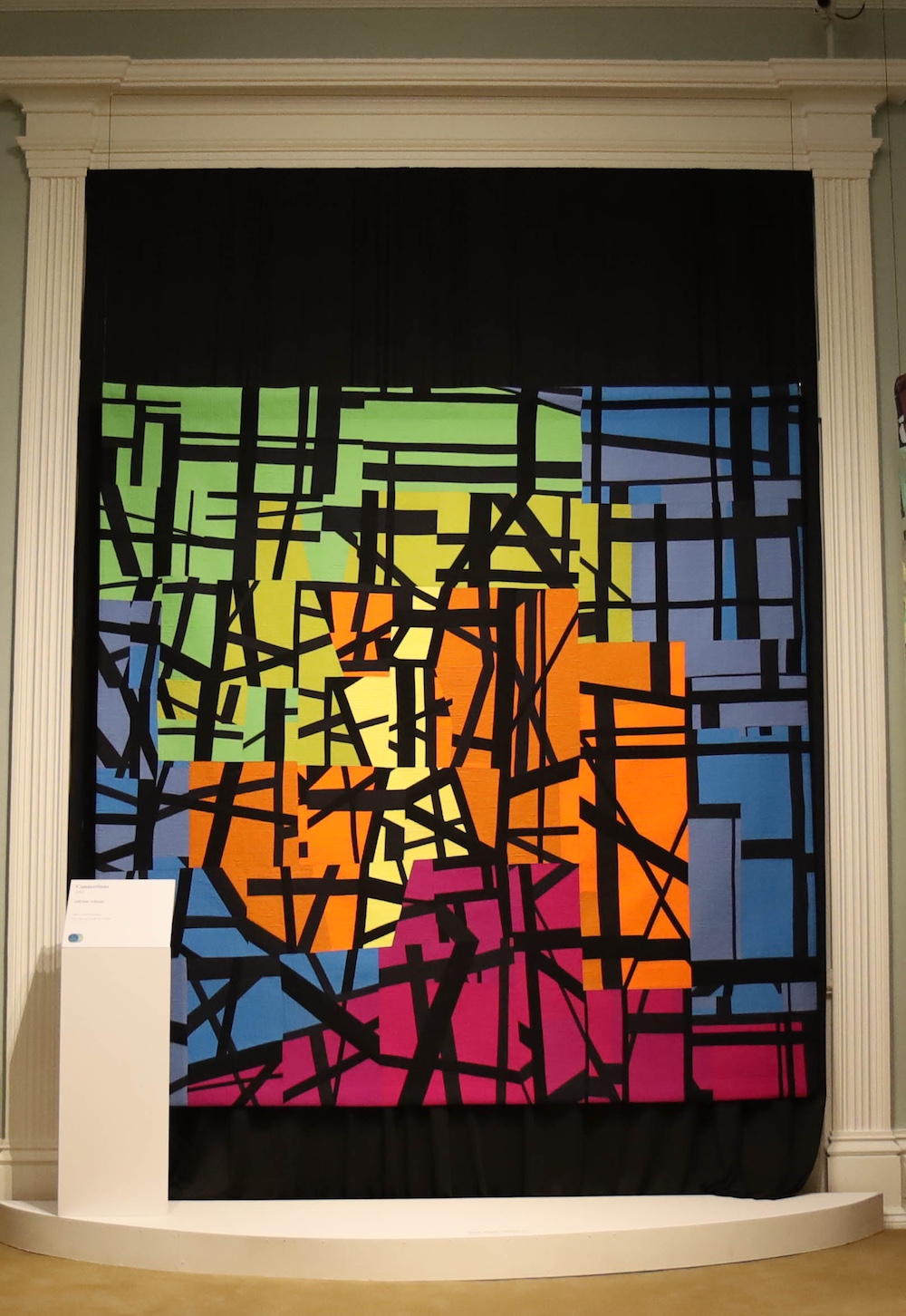
Even a casual viewer can see the precision in the piece. Adams is exacting about her work, so it’s no surprise Crow appealed to her as a teacher.
By the time she first studied with Crow, Adams had already sat through plenty of quilting workshops. In her experience, women rarely critique one another honestly because nobody wants to hurt anyone’s feelings, and teachers worry about the same thing along with filling their classes. Crow sets all of that aside.
Crow “doesn’t suffer fools lightly,” Adams said. “To her, the design ideas are too important to subvert to social ways of being.”
Crow also taught exactly what Adams wanted to learn.
“She didn’t teach technique or ‘quilt my way.’ She teaches basic design principles, which is what I was craving,” Adams said. “I don’t want to make somebody else’s work. I want to bring it from my soul out.”
American modernist painter Georgia O’Keeffe once said, “I found I could say things with color and shapes that I couldn’t say any other way.” For O’Keeffe, painting gave form to feelings she had no words for. Adams’ website bio notes that she has been known to say “words might fail her, but fabric never does,” a riff on that idea.
“Underneath all those wordy, wordy things, there are really deep soul-level ideas that there aren’t words for,” Adams said. “You have to use art. That’s the only way to get it across.”
That carries extra weight coming from someone who speaks English, Spanish and Mandarin. Other languages have words English lacks, Adams said, and even with three to choose from, she still reaches for fabric.
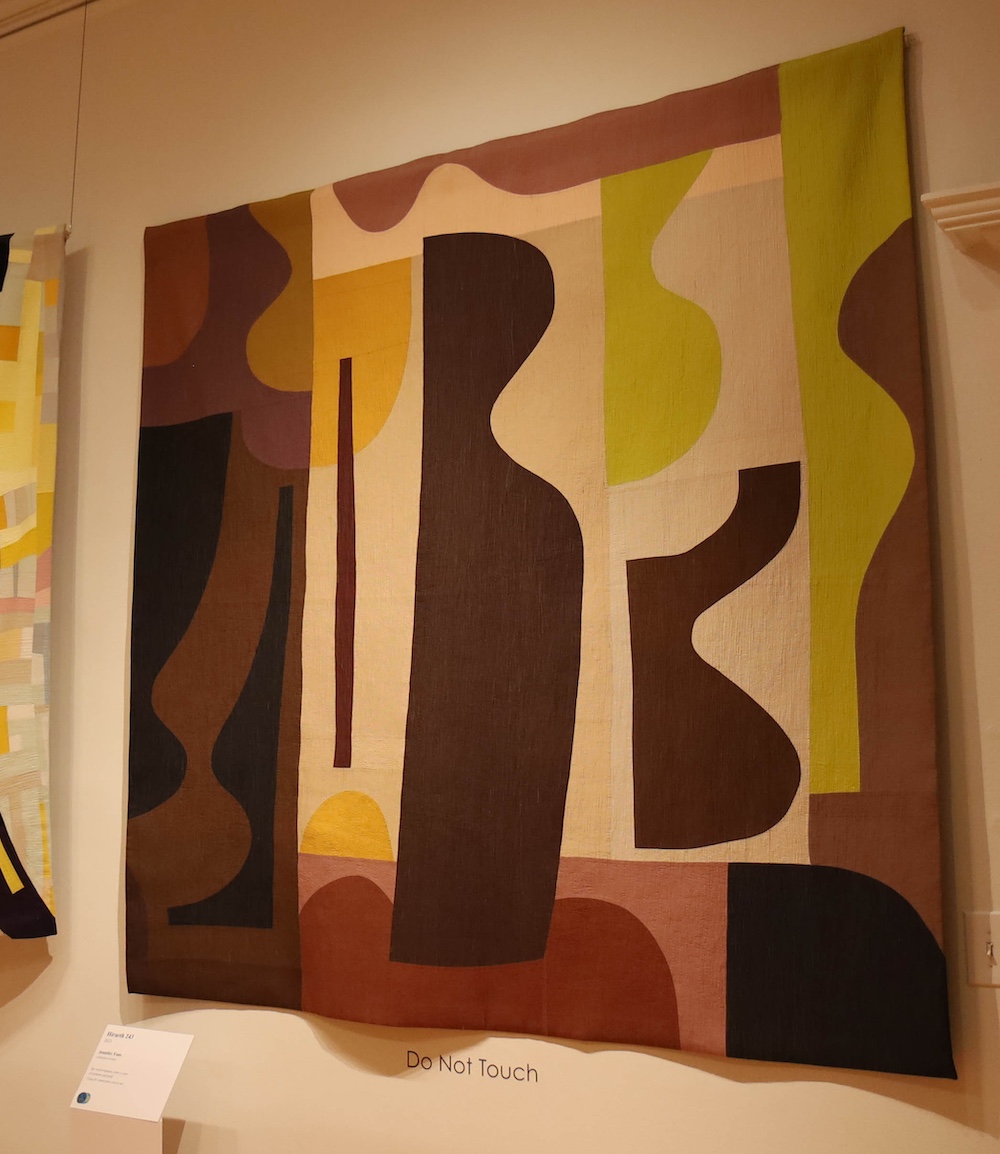
Hiraeth is an 80-by-80-inch composition finished in 2023, runs earthier than most of its neighbors. Dark chocolate and terracotta shapes with undulating edges lock together across tall bands of olive and chartreuse, and a cream ground peeks through at the center. The piece carries a hard-won serenity, with an undercurrent of melancholy worth lingering over.
Fons said that longing ties into her lifelong search to understand who she is, and that search lines up with something Crow pushes hard in her teaching.
“In order to discover who you are as an artist, you have to go back to your childhood and to think about who you are and what is important to you,” Fons said.
Every artist in Color Improvisations 3 studied with Crow, and each went through the same search she asked Adams and Fons to do. The quilts that came out of it look nothing alike, which is the point. Each one carries something personal, and each artist hopes visitors take something different home.
Crow’s own hopes for the show start with what she doesn’t want to see.
“I am at the point, frankly, today, I cannot go to one more exhibition that is about war, corruption, ugliness, nastiness,” she said. “I just have to see something that gives me a sense of joy.”
So she built one.
Upstairs in the Reese-Peters House, cherry red still bursts through those black branches, and lime and yellow still glow above Adams’ darkening grid. The eye can’t settle. That’s the joy of it.
Color Improvisations 3 is on view through Jan. 3, 2027, at the Decorative Arts Center of Ohio. The museum is open 11 a.m. to 4 p.m. Wednesday through Friday and 1 to 4 p.m. Saturday and Sunday, and admission is free.
Fons will present “Color Improvisations: An Artist’s Perspective” at 2 p.m. Sunday, Oct. 25, at the center. She plans to talk about her search for her own voice as an artist, how her roots in traditional quilting shaped her body of work, and what cloth means as a material that stays with people throughout their lives. Advance tickets cost $10, or $5 for members, and door tickets cost $15.