

Communiqué
FRONTLINE’s “Coal’s Human Cost” exposes failure to protect Appalachian coal miners – Nov. 10 at 10 pm on WOUB-TV
By: FRONTLINE
Posted on:
FRONTLINE
“Coal’s Human Cost”
Tuesday, November 10 at 10:00 pm
Working veteran underground coal miners in central Appalachia are suffering from black lung disease at the highest rates in nearly 50 years. It’s now as bad as the 1970s, with thousands of miners sick and dying.
How did this health crisis happen, and why haven’t miners been protected?
Those questions are at the heart of Coal’s Human Cost, an investigative documentary eight years in the making from FRONTLINE, NPR, Public Health Watch and the Appalachia + Mid-South Newsroom. Its Nov. 10, 2026 premiere comes as the Trump administration has been boosting coal mining, with a pledge of nearly $700 million to keep coal-fired power plants running and coal exports flowing.
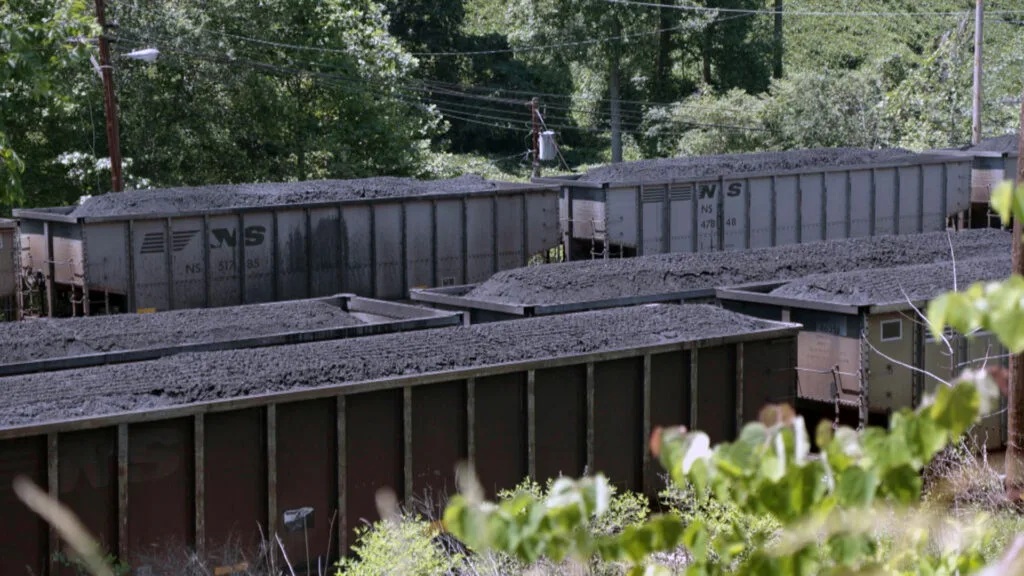
Against that backdrop, Coal’s Human Cost tracks the resurgence of black lung disease in Appalachia, its impact on miners and their families, and the role of the government and the mining industry in failing to protect them.
“One in three veteran coal miners tested in central Appalachia now have black lung, the highest rate since 1978,” says the documentary’s correspondent, award-winning journalist Howard Berkes. “Our new investigation traces the road to this moment, and the ongoing human toll.”
Berkes has spent 15 years reporting in and out of the coal fields of West Virginia, Virginia and Kentucky chronicling the comeback of a disease that’s both incurable and preventable. In the 2019 FRONTLINE/NPR documentary Coal’s Deadly Dust, his reporting revealed an ongoing epidemic of severe black lung disease connected to decades of overexposure to toxic silica dust.
Nearly eight years later, there’s evidence things have gotten worse.
Coal’s Human Cost reports on how black lung disease is currently devastating families in Appalachia, with 2,000 new cases reported by black lung clinics last year alone, and 1,700 black lung deaths reported from 2020 to 2023. The documentary also examines how doctors and advocates have been trying for years to sound the alarm and to get better protections for miners, and how federal regulators and the industry failed to respond.
“You can’t imagine a schoolteacher rate of one out of three getting this disease. The public would put their arms up and scream and stop whatever exposure it was until this got better,” says Drew Harris, a pulmonologist and medical director at black lung clinics who has worked with hundreds of sick miners over the years. “But this has been going on for decades. And we know why this is happening, and it is entirely preventable, and we aren’t preventing it.”
For the full story, watch Coal’s Human Cost starting Nov. 10, 2026, at 10/9c on PBS stations (check local listings) and on FRONTLINE’s YouTube channel, and at 7/6c at pbs.org/frontline and in the PBS App. Coal’s Human Cost will also be available on PBS Documentaries on Prime Video. Subscribe to FRONTLINE’s newsletter to get updates on events, podcasts and additional reporting related to Coal’s Human Cost.
Coal’s Human Cost is a FRONTLINE production with Five O’Clock Films in association with Forage Media. The writer, producer and director is Molly Born. The producer and correspondent is Howard Berkes. The senior producer is Frank Koughan. The managing editor of FRONTLINE is Andrew Metz. The editor-in-chief and executive producer of FRONTLINE is Raney Aronson-Rath.
About FRONTLINE
FRONTLINE, U.S. television’s longest running investigative documentary series, explores the issues of our times through powerful storytelling. FRONTLINE has won an Academy Award® as well as every major journalism and broadcasting award, including 113 Emmy Awards and 35 Peabody Awards. Visit pbs.org/frontline and follow us on Facebook, Instagram and YouTube to learn more. FRONTLINE is produced at GBH in Boston and is broadcast nationwide on PBS. Funding for FRONTLINE is provided through the support of PBS viewers and by the Corporation for Public Broadcasting, with major support from Ford Foundation, and Fialkow Family Foundation. Additional support for FRONTLINE is provided by the Abrams Foundation, John D. and Catherine T. MacArthur Foundation, Park Foundation, Heising-Simons Foundation, and the FRONTLINE Trust, with major support from Jon and Jo Ann Hagler on behalf of the Jon L. Hagler Foundation, and Corey David Sauer, and additional support from Koo and Patricia Yuen, and Laura DeBonis and Scott Nathan. Corporate support for FRONTLINE is provided by The Economist.
About NPR
NPR’s rigorous reporting and unsurpassed storytelling connect with millions of Americans every day — on the air, online, and in person. NPR strives to create a more informed public — one challenged and invigorated by a deeper understanding and appreciation of events, ideas, and cultures. With a nationwide network of award-winning journalists and 16 international bureaus, NPR and its Member organizations are never far from where a story is unfolding. Listeners can find NPR by tuning in to their local Member stations (npr.org/stations), downloading the NPR App or asking Alexa to “Play NPR.” Additionally, listeners on Alexa will also be able to tune in to NPR’s live coverage. Just tell Alexa to “ask NPR to play special coverage.” The NPR mobile app brings together the best of the NPR Network from around the world and right in your community — live radio, podcasts, the latest local and national news and more — available wherever you are and whenever you want. Get more information at npr.org/about and by following NPR Extra on Facebook, LinkedIn, Threads, and Instagram.
About Public Health Watch
Public Health Watch (PHW) is an independent, nonprofit, nonpartisan investigative newsroom focused on public, environmental and occupational health. PHW investigates threats to the health and wellbeing of people exposed to hazards in their neighborhoods and at work. Now in its sixth year, PHW has won more than two dozen major journalism awards for investigations that have inspired legislation, regulation and community action. Major investigative projects include the first reporting of an epidemic of silicosis among artificial stone countertop workers in California, an ongoing series on the people affected by the failure of states to expand Medicaid, how excessive heat in Texas is resulting in astronomical energy bills that threaten public health, and a podcast, “Fumed,” that exposes the failure of regulators to protect Texas residents from chemical and industrial waste. PHW partners with local, regional, national and Spanish-language news organizations. Learn more at https://publichealthwatch.org/ and follow us on X, Facebook, LinkedIn, Bluesky, Threads, and Instagram.
About the Appalachia + Mid-South Newsroom
The Appalachia + Mid-South Newsroom is the essential news source for people in and of Tennessee, Kentucky and West Virginia. NPR and member stations in Appalachia and the Mid-South launched a collaboration aimed at strengthening local news coverage and amplifying more stories from this region to the rest of the country. The Appalachia + Mid-South Newsroom includes West Virginia Public Broadcasting, WPLN and WUOT in Tennessee, LPM, WEKU-Lexington/Richmond, WKMS-Murray and WKU Public Radio in Kentucky. Learn more at https://www.lpm.org/tags/appalachia-mid-south-newsroom and follow us on X, Facebook, LinkedIn, Bluesky, Threads, and Instagram.