

News

New Ohio laws claim property tax relief. But school officials warn the situation is more complicated
By: Amanda Pirani
Posted on:
ATHENS, Ohio (WOUB/Report for America) — School districts are warning constituents that changes to local property tax passed at the end of last year could cause some major budgeting challenges.
“It’s a complete disaster for all of us,” said George Wood, superintendent of Federal Hocking school district in Athens County.
Some lawmakers described the five property tax bills as $3 billion in future relief. But homeowners shouldn’t expect to see cuts to their property tax bills.
Instead, the increases on those taxes should slow down — but not without costs to local school districts, according to local superintendents.
Lawmakers sponsoring the bill said in a press release that the legislation is intended to give voters more agency over the levies they want to support.
“We are for the first time saying no to unvoted property tax spikes and yes to more voter control and transparency,” said Rep. David Thomas, a Republican representing Jefferson.
Beth Blackmarr, the founder of Citizens for Property Tax Reform, said it’s not enough. Her group is one of the organizations gathering signatures to abolish property taxes in Ohio.
She also provides assistance to people at risk of losing their homes because of delinquent property taxes and said the legislation doesn’t do enough to address their financial strain.
“It doesn’t make an appreciable difference in our bills,” she said. “The problem is they’re trying to fix things going forward and not going back.”
Understanding the 20 mill floor
Two of the bills passed will directly affect local school district budgets by targeting what’s known as the 20 mill floor.
To understand these changes, it’s important to first look back at another period of inflationary pressures: 1976.
At the time, homeowners saw rises in property values that caused their taxes to spike rapidly. In response, lawmakers passed House Bill 920, designed to limit tax levy growth caused by inflation.
Local property taxes are collected through levies placed on the ballot and approved by voters. Those levies ask for a particular millage rate, with one mill being $1 of tax for every $1,000 of property value.
Say a home’s value in 1970 was $50,000. A 3 mill levy would cost that homeowner $150. Then, in 1972, that home’s value jumped to $100,000 because of inflation. Now, the same 3 mill levy costs them $300 just two years later.
Voters could have approved a 3 mill levy in 1970 not knowing its cost to them would later double. The change lawmakers made in 1976 was to prevent that from happening.
HB 920 works by creating a “tax reduction factor” applied to tax rates to keep them closer to the dollar value at the time of a levy’s passing.
In the example above, the 3 mill levy might be lowered to 1.5 mills two years later so the cost to the homeowner stays closer to the $150 they expected when approving it. That 1.5 mills is what you might hear a county auditor call your effective rate.
The main takeaway: As property values go up, the millage associated with a levy typically goes down.
That adjustment is the reason local entities may regularly come to the ballot asking for a new levy. Their income from past levies doesn’t grow as costs for goods and services increases.
But there are exceptions to this rule — like the 20 mill floor.
A year after HB 920, lawmakers created the floor to ensure that school districts would still have a minimum level of funding.
Even after a reduction factor is applied to a school district’s levies, the total of its current expenses levies cannot drop below 20. If it does, the state will bump it back up.
That means unlike other levies, the growth of a district’s current expenses levies aren’t capped.
For example, say a school district has 30 mills in current expenses levies. Property values in the district have increased, resulting in an adjustment to 16 mills to produce the same amount of tax dollars as when the levies were passed.
Unlike with a fire or municipal government levy, that adjustment isn’t the end of the story because of the 20 mill floor.
The more the millage rate drops, the more it must be bumped back up to reach the floor.
That “bump” is seen by districts as growth in tax revenue.
“So it is dollar-for-dollar when you see an increase in valuation,” said Cindy Waugh, president of the Ohio County Auditor’s Association. “They see an increase in their revenue, and sometimes it’s a windfall.”
There is one exception to this 20 mill floor bump. If a school district’s total voted millage doesn’t go above 20 mills before the reduction factor is applied, then the district’s current expense levies are not raised up to 20 mills.
School districts will no longer see 20 mill floor growth
Most school districts in Ohio are on the 20 mill floor, meaning as property values spike, so do the taxes paid by homeowners. It’s one of a few cases where levies can grow without voter approval.
But House Bill 186, passed in December, will change that.
The law creates a new GDP inflation factor, which will cap the growth districts would have seen. For homeowners, the new limit on their property tax growth will show as a credit on their bill.
But that doesn’t mean homeowners should necessarily expect a cut to their tax bills. The credit simply shows how much the 20 mill floor growth has been capped and does not lower the millage levied or prohibit growth entirely.
“It can be quite misleading,” said Jill Davidson, the Athens County Auditor. “If they adjust how certain rates are calculated … it primarily limits future revenue growth rather than providing any broad tax cuts.”
Davidson said there are still a lot of unknowns regarding the factor and how it will be applied. The law goes into effect this month, meaning homeowners will see the change reflected in their second-half property tax bills.
Homeowners who do not live in a district on the floor will see no changes.
Schools will not lose any funding already received from the growth of their 20 mill floor revenue. Instead, the credit provided to homeowners will be backfilled by the state using tax holiday funds until the county goes through its next six-year reappraisal or triennial update.
Those funds would have been used to reimburse local governments for a two-week sales tax holiday this August for a range of goods and services. While the expanded holiday is canceled, the state will still offer its annual three-day sales tax exemption on back-to-school items.
That change has left school officials frustrated that income already budgeted for in their five-year forecast will now be lost.
“It blew about a half a million dollar hole in our budget,” said Wood, superintendent of Federal Hocking.
Wood emphasized that Federal Hocking is just one of many districts that will be hit by the change, because every district on the 20 mill floor produced a budget forecast before the new laws were passed.
In Federal Hocking’s case, that means a projected budget deficit will double from $250,000 to nearly $500,000. Wood said the district will have to tighten its belt further than planned and look at reducing personnel costs.
The 20 mill floor is made up of current expenses levies, used to fund a school district’s year-to-year operating costs. Levies can only be used for what was described on the ballot when they were passed, meaning that a school district cannot simply pull operating money from another pool of funds.
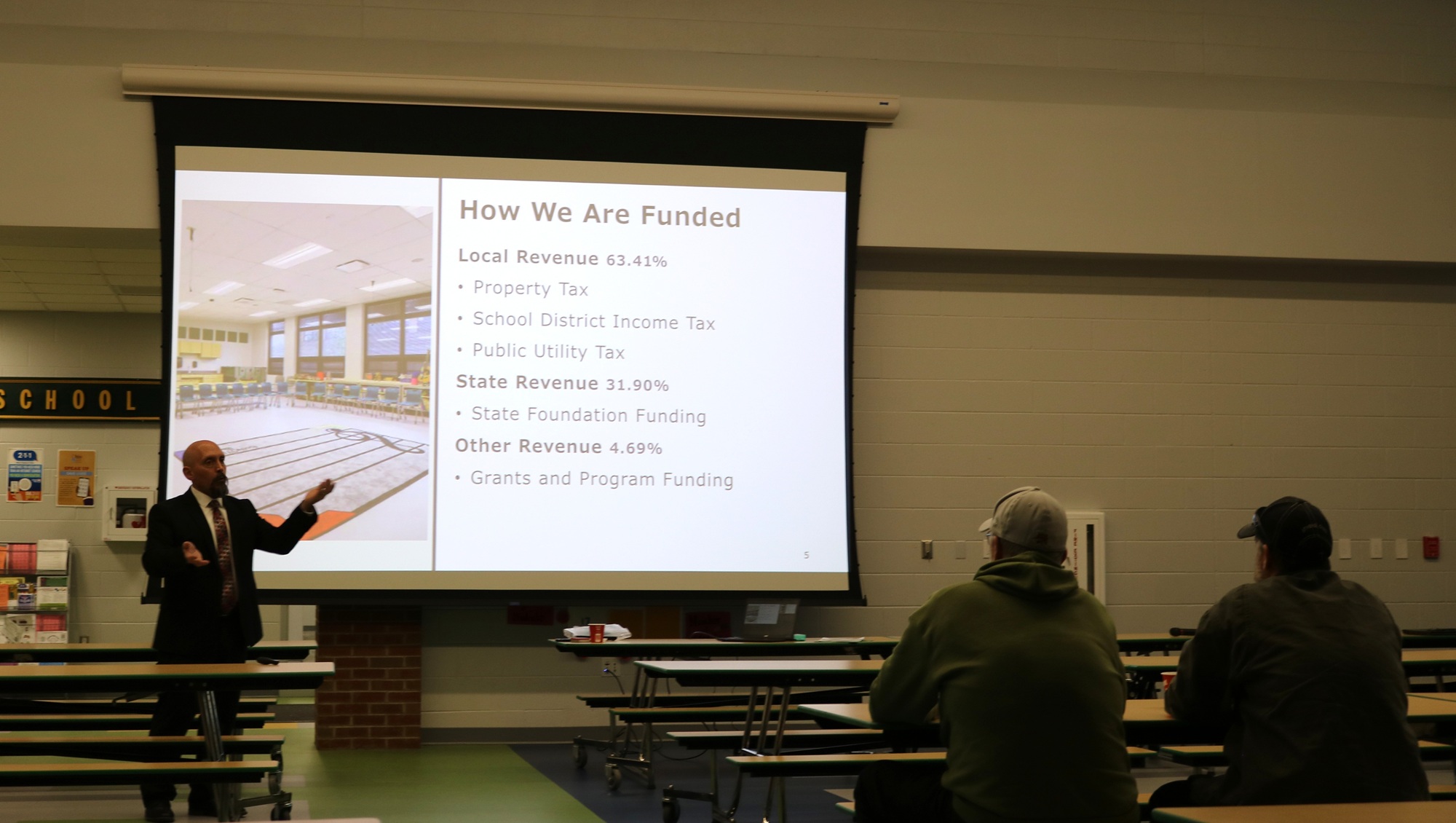
In a public meeting about the new legislation, Athens City Schools estimated it would lose about $600,000 in millage growth next year. In four years, the district will run out of cash reserves if no changes are made to its current income streams.
Catherine Bowditch, a member of the Athens Parent Teacher Organization, said she’s worried about how the changes will affect the district.
“What are we going to cut that hasn’t already been cut that we would all think is OK?” she asked. “I can’t think of anything extra.”
Wood said that because the change was made without any adjustment to the state’s school funding model, rises in property values could instead count against the district. That’s because property values are one of the factors that’s used to calculate state funding.
“Our state share could diminish … because it would say you don’t have a lot of kids, but you’ve got all this property wealth,” he said. “But we can’t tax on all that property wealth. So it’s another way this is going to hit every district.”
HB 129 could move many districts above the floor
Another new law will change how the 20 mill floor is calculated, making major changes to some district budgets.
There are a few different kinds of levies available to school districts, some of which can only be used for specific purposes. Previously, only levies used for current expenses could be factored into the 20 mill floor.
House Bill 129 will change that, counting fixed-sum operating levies toward the floor. Fixed-sum levies, sometimes referred to as emergency levies, are designed to raise a specific dollar amount for a set period of time.
During a public meeting about the financial future of Athens City School District, superintendent Chad Springer explained that Athens is one district that will be moved above the floor because of the change.
“That’s 1.2 (million dollars) less in anticipated revenue,” he said. “A third of all school districts are coming off the floor.”
Moving above the floor means some school districts will see less total millage than before, resulting in the kind of budget loss Springer described.
The most important thing to understand is that not all levies count toward the 20 mill floor.
Before HB 129, only current expense levies counted.
So, say school District A over the years has passed 34 mills of current expense levies. And say this year those levies now total 17 mills because of the reduction factors.
The district also has another levy that doesn’t count toward the floor and comes out at 5 mills this year.
Since the school’s current expense levies have dropped below the floor, state law required that those 17 mills be bumped up to 20. The other 5 mills didn’t count, because that levy was not a current expense levy.
So in total, school district A had 25 mills of tax revenue.
But now, under HB 129, the 5 mills now counts toward the floor. So after the reduction factors, District A still has 17 mills of current expense levies, but the 5 mills must also be considered before deciding if the district needs to be bumped to 20 mills.
Since counting that 5 mills puts District A at 22 mills, it’s above the floor and will tax at that amount instead.
From the district’s perspective, that’s a 3 mill loss in funding it would have received before.
But for homeowners in affected districts, this change will look like a decrease in the growth of their property tax bill.
| District A | Before HB 129 | After HB 129 |
| Current expense levies after reduction factors | 17 mills | 17 mills |
| Other levy (not current expenses) | 5 mills | 5 mills |
| Adjustment to bring district to the 20 mill floor | +3 | 0 (5 mills now counts toward the floor) |
| Total | 25 mills | 22 mills |
As voters grow wary of property taxes, schools turning to other options
School districts are now assessing what the tax changes mean for their budgets, though leaders say there’s still many unknowns.
Springer said it’s important to help parents and taxpayers understand the changes at hand, because many schools may have to ask for new levies sooner than planned.
“A majority that are in our boat, that are coming off the floor, are already going on the ballot this coming November for new money,” he said.
It’s not yet clear whether Athens will be one of those districts. It has already made some cost-cutting moves and absorbed two staff positions last year.
With new property taxes becoming increasingly unpopular, and schools no longer able to benefit from the growth of the 20 mill floor, some districts are taking a new approach: local income tax.
“That is only charged to people earning an income,” Wood said. “That means if you’re on Social Security … you don’t pay it.”
Last year, Trimble Local Schools in Athens County passed a 1% earned income tax with 51% of the vote in an effort to climb out of its financial crisis. In Tuscarawas, New Philadelphia School District will place a 1.5% earned income tax on the ballot in May for the construction of new school buildings.
Wood said Federal Hocking’s school board may also consider an income tax to address its budget deficit, though nothing has been decided.
Other property tax changes to have broader impacts
Three other bills were included in the package of bills targeting property taxes. One limits the growth of inside millage, similar to HB 186’s effect on the 20 mill floor.
Inside millage is 10 mills that tax jurisdictions in Ohio can levy without voter approval, divided up among different local entities like school districts and governments. Inside millage has historically not been subject to the reduction factor, meaning that as property values went up, so did the millage.
Now, House Bill 335 will prevent that growth by applying an inflation-based cap.
Since school districts are one of many local entities that receive inside millage, this will be another limit on their income. Other local entities like municipal governments will also see stagnation in their revenue.
Township or village administrations often rely entirely on inside millage to fund their operations.
House Bills 309 and 124, while labeled as property tax relief bills, won’t directly have any effects on local property taxes.
HB 309 clarifies the ability of budget commissions to reduce levies they find excessive, while HB 124 gives county auditors more authority in the process of selecting property sales for tax assessment studies. That change should make property reevaluations more accurate, according to Davidson, the Athens County auditor.
Some of these changes, like HB 186 and HB 335, were supported by the legislature’s property tax working group, which made 20 recommendations to address the issue last September.
Proposals that did not see movement as a result of the recommendations include implementing a tax deferral program for some senior citizens, a bill reducing property taxes for some low-income senior homeowners and implementing what’s known as a property tax circuit breaker.
Generally speaking, a circuit breaker caps the amount of property taxes someone has to pay in proportion to their income.
Athens Mayor Steve Patterson, who was part of the working group, was critical of the lack of support for reforms that might cost the state.
“When we started the conversation around property tax reform … the first words out of their mouth, which was frustrating for me, was the state legislature will not write a check,” he said.
Waugh said that while the County Auditors’ Association supported the changes made by the bills that passed, it would have also liked to see an expansion to the homestead exemption.
That’s a program to provide property tax reductions to people who are disabled, older than 65, or the spouse of a first responder killed in the line of duty. The exemption shields $29,000 of one’s home value from taxation.
Right now, people who are disabled or older than 65 must have an income under $40,000 to qualify.
Waugh said the auditor’s association would have liked to see that income cap raised.
“We wanted to raise up the amount of discounts that they were getting,” she said. “Because I think that’s your most vulnerable Ohioans, is your 65 and older.”
Another homeowner tax credit was expanded by recent legislation, though not without rolling back another program. HB 186 will expand the owner occupancy credit to 15.38% over the next three years, while phasing out the nonbusiness credit for residential properties.
The owner occupancy credit provides a tax credit to those who own their home and live in it full time. The nonbusiness credit was provided to residential property owners regardless of whether they lived in the property full time.
What do the changes mean for communities?
Davidson said the changes will require local institutions to either decrease their services or place levies on the ballot more often.
“So the state’s kind of wiping their hands, saying, what we’re doing is putting the guardrails in to limit the growth,” she said. “So if the voters really want to support these tax levies, then they’re agreeing to pay the price to continue to have that level of government.”
She said it was frustrating to see lawmakers target local inflationary growth, when, at the same time, sources of state revenue like sales tax and income tax continue to benefit from the same growth. Inflationary growth has been allowed so that as the cost of goods and services increased, local governments could continue to provide the same level of service.
The reasons for property tax spikes are complex. The COVID-19 pandemic’s effects on the housing market had national repercussions. But in Ohio, some experts say those repercussions have been exacerbated because of a unique reliance on local funds for governments, schools and other institutions.
Wood, the Federal Hocking superintendent, said most school districts in the county are paying most of the per-student educational costs, while at the same time, the state has increased funding for private school vouchers.
“We don’t even get half of the state allotment per child,” he said. “We get 42%. So the local taxpayers are paying 58% of the cost to educate a child.”
Over time, state funding cuts, tax restructuring, property tax exemptions and abatements have led to less funding for local jurisdictions. Davidson said property tax reforms will have to include more funding on the state’s part.
“I believe that what really needs to happen before we’re going to be able to remove the threats of removing property taxes altogether, is the state is going to have to own up to some of the responsibility,” she said.
Amanda Pirani is WOUB’s Report for America Journalist covering Economic Livelihood. For more information about Report for America, you can click here.