

News
Volunteers document Meigs County flood damage in hopes of federal assistance
By: David Forster
Posted on:
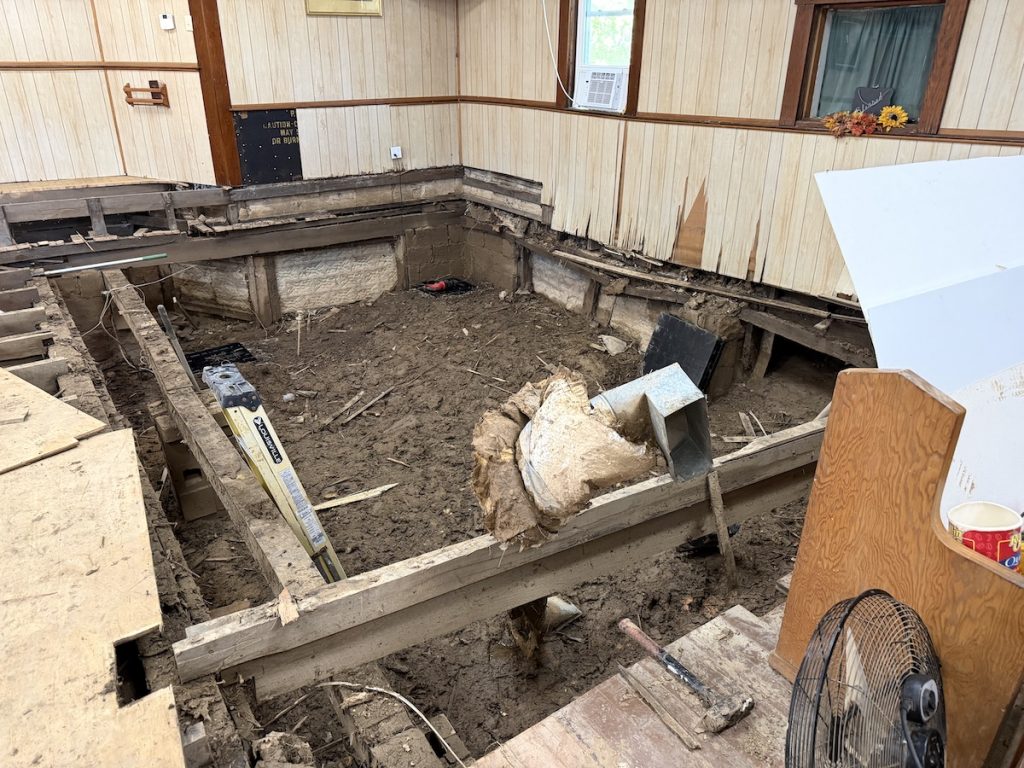
RUTLAND, Ohio (WOUB) — Steve Tomek is standing on what little floor space is left at Community Church in Meigs County, where his father has been pastor for 27 years. Half the floor is gone, exposing the bare ground below.
The pews, the pulpit and other items are packed tight onto the other half of the Rutland Church. The wall paneling is split and peeling after soaking in more than half a foot of water from the recent flood that swept through this community.
“We don’t normally greet our visitors like this, but this is what we got right now,” Tomek says. “Hopefully when you come back the floor will be about 10 inches higher and have nice carpet on it.”
Tomek is talking with two volunteers from the Meigs County Emergency Management Agency, Josh Fisher and Brian Taylor. They are among several teams of volunteers visiting homes and businesses throughout the county to assess flood damage.
At each stop they work through a checklist of questions on a phone app and document the damage with notes and photos. It’s the first step in the multistep process of trying to get some aid from the federal government.
“We’re not beggars, but financially for a small church what we’re undertaking is a huge task,” Tomek says. “We hauled $3,000 worth of lumber yesterday. So, financially that’s hard on us.”
Fisher explains it’s too soon to say whether or even if government assistance will be coming, or how long that will take.
Meanwhile, scam artists are already circulating in Meigs County presenting themselves as representatives of the Federal Emergency Management Agency, better known as FEMA.
“A few days ago I had someone say, well, FEMA was here yesterday,” Fisher says. “And I said, did they give credentials? Well, they said they were FEMA. And I said, well, FEMA’s not in this area right now.”
The scammers will ask people to make a payment up front for repair work. Fisher says this is not how FEMA operates and he cautions against making advance payments to anyone offering help.
“A lot of scams can be created out of someone else’s tragedy,” he says.
Finding materials and laborers can be challenging in Meigs County
Many flood victims cannot wait for help to arrive to make their homes habitable again or get their businesses reopened so they can have some income. And for those who cannot afford to hire someone to do the work, they are doing what they can on their own to clean up the mess and at least begin to rebuild.
This is the case at the church. Tomek and his brother have not only ripped out much of the floor but also damaged floor joists. Stacked in front of the church is a pile of debris nearly 5 feet high. Tomek says it’s less than half of what’s been hauled away already.
They’re anxious to get the church back open, but just sourcing materials to make the needed repairs has proven to be a challenge in such a remote area.
“You don’t know where we could get basement jacks, do you? About 1-foot tall basement jacks?” Tomek asks. “I’ve tried finding them locally.”
Fisher says he’ll make a note to ask around.
Across the street from the church, James Birchfield leads the volunteers through the funeral home he has operated for 35 years.
“We got walls to replace back here,” he says. “We had to get in here and clean the mud out quick because we had a body in the cooler and another funeral home was coming in to pick it up.”
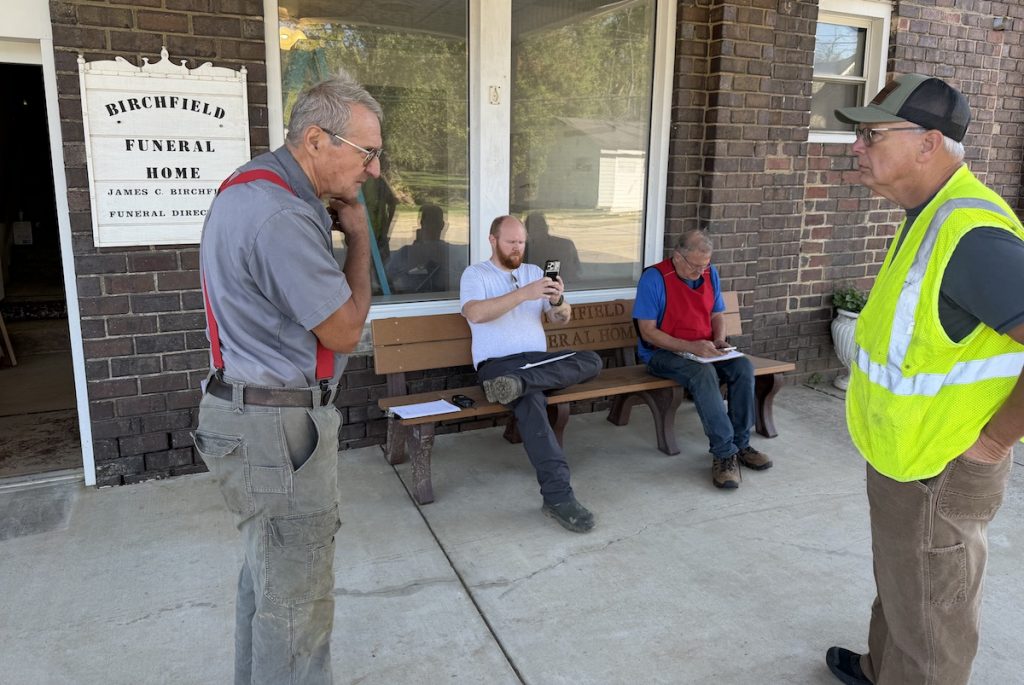
Birchfield has already ripped out the carpets and baseboard. The drywall will need to be replaced at least two feet up the walls. He has flood insurance — many flood victims do not — but it may be weeks before he learns what will be covered.
His biggest challenge right now is finding people to do the work.
“I think I’ve found somebody to do my drywall,” he says. “But the wallpaper, I have no idea who even hangs wallpaper anymore, let alone where you can even find it.”
Despite all the damage, the work ahead, and the disruption to his business, Birchfield is taking it in stride.
“I’ve lived here long enough, I don’t pay no attention. I just deal with it and go on,” he says. “Mostly it’s attitude.”
“I couldn’t believe what had happened”
“No livestock?” Jeff Needs asks as he lifts the latch on a large steel gate.
“No, I’m thankful I didn’t have any livestock,” answers Sharon Jewell. “We used to have it, but don’t anymore.”
Needs and the other volunteers walk with Jewell down to a creek that runs through her farm. A bridge was damaged by the flood and she wants them to check it out.
Jewell has lived her entire life on the farm her grandparents bought in 1918. She has lived here alone since her husband died four years ago.
She says the creek has flooded before, but nothing like this.
“I couldn’t believe what had happened,” she says. “I’m 85 and this is the worst flood that has ever been in my lifetime.”
Jewell says when she opened the front door of her two-story farmhouse at daybreak the morning of the flood, all she could see was water, right up to the lip of her porch.
For some perspective, Jewell’s house is more than 100 yards from the creek, some of it uphill.
“It’s a 100-year flood at least, or 150,” she says.
Outbuildings close to her house flooded with about 20 inches of water. Jewell has spent the past several days hauling storage bins out to the front lawn one by one, sorting through to see what is salvageable. Much is not.
“There was no way I could get to anything to save anything,” she says. “Things I had stored that I thought was safe, they weren’t.”
Jewell knows she’s more fortunate than some. At least the water didn’t enter her home, and her car still runs. But as volunteer Fisher notes, this can be of little consolation when coming to terms with what has been lost.
“We can compare and say, well, others had it worse, and that may very well be true, but that doesn’t lessen what happened to you,” Fisher says.
“No, it don’t make me feel any better,” Jewel says. “I’m just thankful it wasn’t any worse than it is.”