

News
Guernsey County is now the 11th in the region to see a proposal for a data center
By: Amanda Pirani
Posted on:
ATHENS, Ohio (WOUB/Report for America) — Guernsey County could join nearly a dozen other counties in the region expecting a data center development.
But if a development moves forward, it’ll do so without the support of county commissioners.
“I would say the people have spoken,” Commissioner Jack Marlin said. “They’re against data centers. We said we were against it. So I don’t see how we come back from that.”
It’s a break away from surrounding counties, where local officials have generally supported data center developments believing they will provide economic benefits — sometimes sparking backlash from residents.
The proposal was first made public during a June 9 presentation to county commissioners by local real estate agent Jason Miller and chief executive officer of Smart Energy Partners Rich Stokey.
Smart Energy assesses and coordinates site and power acquisition for data centers and is advising Miller, who has 425 acres in the county he might develop.
Right now, Stokey said they are just evaluating the potential for a data center in the county and wanted to gauge the commissioners’ interest.
Guernsey does not have countywide zoning. That means the commissioners have no approval or regulatory authority over any development in the county, if it takes place on private land.
They would have a say over any property tax abatements that come before them for approval.
A data center could still be subject to municipal zoning depending on the location.
Smart Energy Partners presents project to commissioners
Stokey, who would only take questions via email, said there is no formal plan for a data center right now and many details are still to be determined.

Stokey is also the strategic energy advisor for Ohio CAT and works to “support accelerated growth across data center, hyperscale, and mission-critical infrastructure markets in Ohio and the broader Midwest.”
CAT, or Caterpillar, is a construction, engineering and mining equipment company. The company’s natural gas engines are in high demand for data centers.
When asked about potential power sources, Stokey did not clarify whether CAT generators were one source under consideration.
Meeting minutes from the presentation to county commissioners state Stokey described a project that would potentially use a closed-loop system requiring minimal water and behind-the-meter power generation using natural gas.
The minutes also describe potential for “airport area development” suggesting that may be the site under consideration. The Cambridge Muni Airport is located three miles south of the city.
In response to WOUB’s questions about what water, land and electricity use for the potential project might look like, Stokey said these details haven’t been decided.
Because the potential development is in the early stages, he doesn’t believe community input is appropriate yet.
“That … also matters more broadly because premature assumptions can put private citizens, landowners, local officials, and community members in the middle of a public debate before there is a defined project to evaluate,” he said.
He added that if Miller, the landowner, and Smart Energy Partners pursue a data center project, further information will be provided to commissioners and the community through the public process of permitting and local government review.
Community organizes in response to proposal
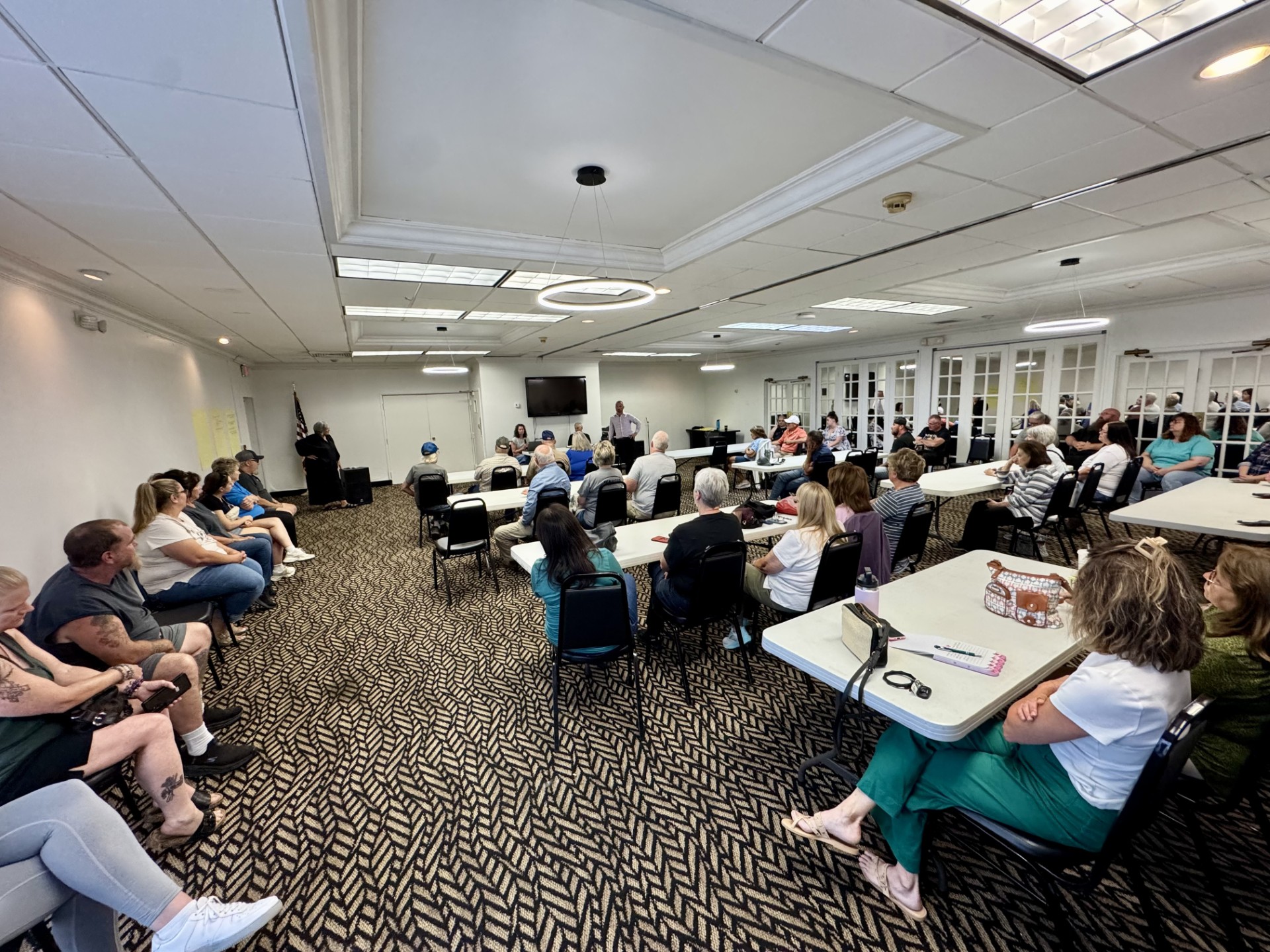
More than 50 residents met last week to discuss a “coordinated strategy aimed at protecting the county’s agricultural land, infrastructure, and ecological resources,” according to a news release from Guernsey County & Ohio: Data Center Developments.
Residents Amy Kissinger and Geno Riley co-lead the organization. They’ve been considering the possibility of a data center in Guernsey County since February and started a Facebook group to monitor local development.
Kissinger said residents are worried about the impact a data center might have on agricultural land, green space and the local water supply.
“We understand that technology is advancing and that this is an industrial movement that is happening and needs to happen,” she said. “I believe many of us agree with that. But what we don’t agree with is it happening in a way that permanently destroys our agriculture or our natural resources.”
Kissinger and other residents have speculated where the site could be, though that information hasn’t been publicly announced.
She’s hopeful Stokey and others involved will respond to opposition by searching for an alternative location.
“I’ve already heard criticisms … that we just want to stay poor, that we’re against advancements and new technology,” she said. “I think just because we might be more desperate for economic progress does not mean that we should be taken advantage of and given the wrong type of economic development.”
The Guernsey County commissioners are working with community leaders like Kissinger to organize a town hall meeting on data centers this month but are still determining a date.
In the meantime, she’s been in close contact with her state representatives and wants to see state legislation offer more protection for unzoned, rural counties like hers.
Without zoning, commissioners play limited role in development
While some residents have raised questions about whether zoning regulations are needed, the commissioners said it remains generally unpopular.
“If it were to be put on the ballot, it would probably not pass here by a large margin,” said Commissioner Bill Cowgill.
Without those regulations, commissioners don’t have the power to review, approve or deny a development. But they will have a say over any request for a property tax abatement.
Commissioner Dave Wilson said that’s a hard ask when looking at sales tax breaks already granted under the John Kasich administration at the state level.
“When you see a deal has been cut like that, and plus Ohio already has I believe it’s 217 data centers, we don’t see where it’s a good value for Guernsey County,” he said.
Databases vary in their estimates for the number of data centers in Ohio, but all of them are over 200.
Wilson added that there are concerns about what a data center would mean for local water sources like the Pleasant City aquifer.
That aquifer is designated by the Ohio Environmental Protection Agency as a sole source aquifer, meaning that it’s the only viable source of drinking water for at least half of an area’s population.
Withdrawals from sole source aquifers don’t require review from the Ohio EPA and are governed by Ohio’s reasonable use doctrine.
Stokey, the Smart Energy Partners CEO, wrote in his email to WOUB that he believes the technology exists to build data centers responsibly and hopes people will consider the specifics of an individual development.
Wilson said if a developer wants to convince the public of that, they’ll have some work to do.
“If they’ve got a story to tell, it’s going to be up to them to do the selling,” he said.
Amanda Pirani is WOUB’s Report for America Journalist covering Economic Livelihood. For more information about Report for America, you can click here.