

Culture
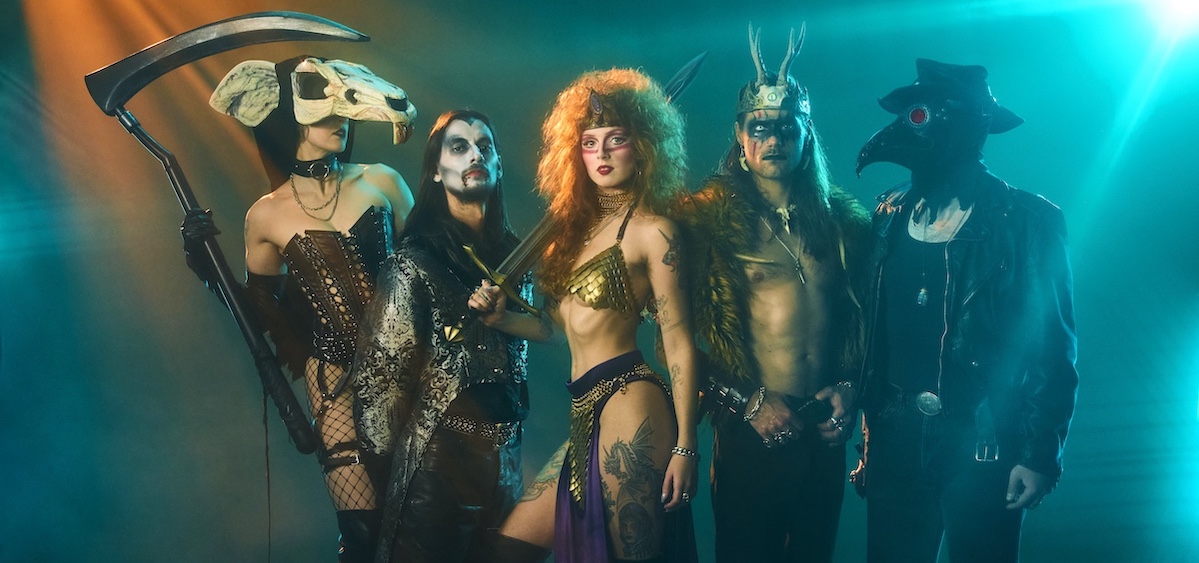
Castle Rat’s Riley Pinkerton talks life, death and 12-foot rats with WOUB ahead of Sonic Temple
By: Nicholas Kobe
Posted on:
COLUMBUS, Ohio (WOUB) – High fantasy has long been part of rock and metal’s DNA, going back to Black Sabbath and Led Zeppelin. Now, in the 21st century, Castle Rat is keeping that spirit alive while adding their own spin.
Formed in 2019, Castle Rat became known for their Sabbath-inspired take on doom metal and an elaborate live show centered on the struggle between lead singer Riley Pinkerton, AKA The Rat Queen, and the “Rat Reaperess.” Their early touring and 2024 debut LP Into the Realm earned a loyal fanbase, with fans showing strong support when the band launched a crowdfunding campaign for their second LP, The Bestiary, which was fully funded in just 37 minutes.
Released in 2025, the record expands both Castle Rat’s sound and the world they’re building. The band is now set to tour the U.S. with Amon Amarth and Dethklok, bringing “The Realm” to Sonic Temple 2026 this spring. Castle Rat will perform May 17 alongside Tool, Godsmack, Megadeth and Public Enemy.

NICHOLAS KOBE: How would you describe Castle Rat in one sentence?
RILEY PINKERTON: Like looking at a Frank Frazetta painting while listening to Black Sabbath.
Kind of going off of that, Castle Rat incorporates fantasy elements into heavy metal. Why do you think those two media genres have worked so well historically together?
PINKERTON: That’s a good question. I think both offer a similar sense of empowerment. Fantasy is really helpful, not just as an escape, but as something that can set an example or inspiration in your own life, like seeing the hero’s journey and then applying it to your own life. I feel similarly about heavy metal, where there’s just this sort of innate sense of power that it brings.
What in the story and the music of Castle Rat represents you trying to bring that kind of fantasy or power to the audience?
PINKERTON: The core feeling that I want to instill with Castle Rat is a sense of belonging. Every show we refer to as “The Realm,” and everyone is welcome in The Realm. It’s about being in the present moment and being together as a group, and the power that comes from that. The overarching story is sort of life versus death, not necessarily good versus evil. I battle death on stage in the form of the Rat Reaperess.
I start a “call and response” chant with the audience, which is “now is forever in this realm.” It stems from the idea that the best kind of antidote to death is living, and the best way to make sure you’re living is to stay in the present moment rather than worrying about what’s in the future or stuck in the past.
In past interviews, you’ve mentioned that the on-stage story of Castle Rat reflects your own anxieties around death. How did that realization shape the storytelling going forward?
PINKERTON: That’s a good question. It took me a couple of years to realize it, which is funny because it’s so blatant. I was like, “it’s a story on stage,” and then I put it together and thought, “wow, I’m such a mystery to myself and nobody else.”
One thing that’s changed is that it’s not good versus evil. Even though we’re the main characters and want the audience on our side—and people boo the Rat Reaperess—I never call her evil or bad. She’s more of a disruptor, the way death disrupts life. That’s something I want to explore more, maybe beyond the stage in something like comics or another format.
From her side, she’s just doing her job—it’s the natural order of the universe. When the plague doctor turns our guitarist into a vampire, that disrupts what’s natural, and that’s what upsets her. From her perspective, we could just as easily be the bad guys.
That’s a direction I want to explore more, to give her depth. For me, death isn’t bad, but it is a mystery—and that’s what makes it something I’m afraid of. So I’m trying to reframe it.
What kind of additional multimedia would be the best fit for expanding the Castle Rat universe?
PINKERTON: Yeah, I love the visual stuff so much, obviously. I have a background in drawing and painting, and I make all the masks, props, and character designs for Castle Rat. The ultimate goal would be a Castle Rat movie—we’ve been sitting in the van on tour talking about what it could be like and throwing around ideas, which is really fun.
I think there’s something about Castle Rat that can be applied to different things. We actually just had someone send me a finished short comic book in a throwback ’70s underground art style that I’m really excited about—it looks like it’s from another time, like watercolor and psychedelic. Right now we’re figuring out when to launch that.
Maybe one day there’s a book. I’ve thought about finding a writer to work with, because I have the story in my head, but I won’t sit down and write it—I just need to yap at someone and have them structure it. I’d get overwhelmed. I’m already doing a few jobs, so figuring out how to write a novel—I don’t know.
Speaking of those jobs, you sing, play guitar, make the masks and build this world. Are those difficult to juggle? And if so, how do you manage that?
PINKERTON: It is, and it isn’t. There are plus sides. Sometimes musically, the creative juices aren’t flowing, and rather than just being like, “Oh, I’m not inspired to write anything right now, so now there’s no forward movement in the band.” I can be like, “all right, that’s not happening for me right now. What can I do on the visual side to feel like I’m productively moving things forward?”
Then it works the other way too. If I’m like, “I can’t make stuff, then I can pick up a guitar.” So it’s nice to juggle those different aspects and still feel like I’m contributing. But I’m definitely the queen of biting off more than I can chew—setting crazy deadlines, waiting till the last minute, and then I’m up till 3 a.m. making a rat mask. Everyone’s like, “How are you gonna pull it off?” And I do—but I am the classic creative brain.
Now that you’ve had time to take The Bestiary on the road, how does the record feel playing it in front of audiences?
PINKERTON: It’s great—I’m so proud of what we made. There is this thing that always happens—we weren’t able to road test the songs before recording. We set a crazy deadline because we wanted a second album out within a year. It was awesome and really hard—I cried a lot—but we got it done.
After two months of touring, the songs get more “lived in,” and my vocals settle in. I live the song night after night, and then I hear the record and think, “Man, I sing it totally differently now.” Not changing the melody, just delivery. I don’t think there’s a way to avoid that unless you tour a record for a year before recording, which doesn’t really work for Castle Rat because everything’s tied to a story.
I try to see records as a snapshot in time. Even if we played them longer, they’d change again. I just have to accept that—it can be stressful, because once it’s recorded, that’s what it is forever. But I’m really pleased with it. It was ambitious, and I’m happy with how it turned out.
Are there any songs that have been especially fun to play live?
PINKERTON: “Siren” is really fun—it has a thrashy part at the end where Franco gets to totally shred. It’s the one where we get a little bit of a pit going. We’re not the “pittiest” band, but some shows get really lit. We played Spain and there was a lot of moshing—it was rad, a very enthusiastic crowd.
You’re heading into Sonic Temple in Columbus—how do you adapt the full Castle Rat stage show to a shorter festival set?
PINKERTON: It’s tricky. For this tour, we’re going back to the original show format—more of an introduction to the characters. The Bestiary concept really needs an hour, but we’re opening for Amon Amarth and Dethklok, so we wanted to keep it simple and get people up to speed.
We’ve condensed it to 30 minutes before, so we know it works. We’re trying to balance the theatrics and lore with still feeling like a band playing music. The cool thing is we’re on bigger stages, so even with less time, I get to go bigger physically—I’m working on a 12-foot rat puppet.
That’s all stuff you’re making yourself?
PINKERTON: Yeah, with help from my friend Cam Finley, who’s an amazing fabricator. He’s my guiding light—he shows me how to do things, but I’m in there doing the work with him.
Was there a favorite prop to make?
PINKERTON: The puppet we’re about to build. I made the head for our first album release show—a giant rat head with glowing eyes and smoke coming out of its nose. The wings I made back then fell apart, but the head held up. It’s been sitting in storage, and now I get to bring it back and build the full puppet. I’m excited to finally bring it to life.
What’s next for Castle Rat?
PINKERTON: I’m bouncing around ideas for a third album, but nothing’s set yet—we’re still busy with The Bestiary. I want to kick down the door genre-wise. We started doing that on this record—moving beyond Sabbath-style doom into more traditional metal, even an a cappella track and some folk elements.
With the next one, I want to really push it—like, “we are Castle Rat, we can do anything.” We’re not just a doom band. Time travel is part of the world, so I’d love to pull from different decades. The first record felt very ’70s, The Bestiary leans into ’70s and ’80s, so maybe the next one goes ’90s—and then maybe the fourth album, I’ll be Britney Spears or something.