

News
Athens City Council approves citywide zoning for temporary emergency shelters
By: Amanda Pirani
Posted on:
ATHENS, Ohio (WOUB/Report for America) — Temporary emergency shelters will now be permitted in Athens’ multifamily housing zones, after council approved a change to city zoning code during its final meeting of 2025.
The vote came after council passed a related ordinance last month, allowing for The Gathering Place to build three temporary shelters in its adjacent lot on North Congress Street as part of its Conestoga Hut pilot project. The organization serves those in recovery from trauma, a mental health issue or substance use disorder.
The ordinance approved this week would allow similar shelters to be built in any R-3 or B-3 zones, which includes multifamily housing and businesses. The shelters are described as temporary in reference to their structure, which lack a permanent foundation and are otherwise unattached to property.
However, the change is not without conditions. The shelters will be required to have one sink and one toilet for every three units, and any proposals will be subject to the approval of the Board of Zoning Appeals. Shelters will also require annual approval from the service-safety director.
Gathering Place Director Ginger Schmalenberg said during the meeting the ordinance’s passage will be critical to using newly received funding for a more permanent micro-shelter project elsewhere in the city.
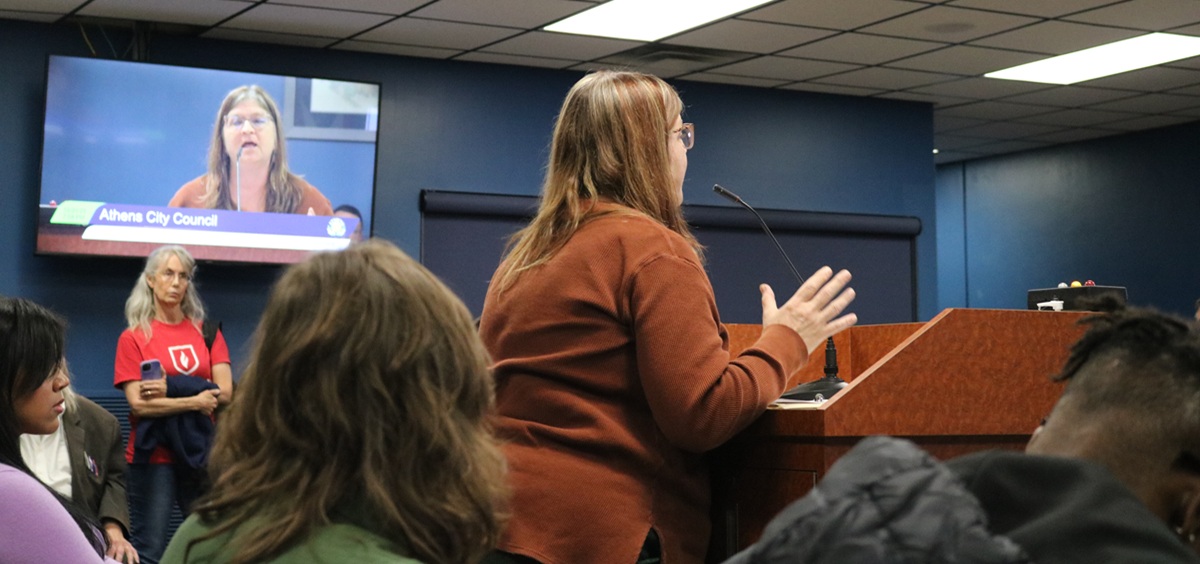
At third reading, councilmembers and residents remain in disagreement
The ordinance has been the subject of tense debate between council members, with Councilmember Alan Swank expressing repeated concerns regarding the zoning change.
“We can do better than temporary structures and porta bodies and a parking lot,” he said. “There are better places than along our main thoroughfares, in our shopping districts and along a road that has 31,000 cars a day that pass up and down East State Street.”
Swank has also suggested the legislation lacks adequate public support.
“I honestly believe that if you were to put this on the ballot, it would fail,” he said in a meeting last week.
Councilmembers Solveig Spjeldnes and Jessica Thomas attempted to assure community members that establishing temporary shelters will require a thorough process.
“There is this perception in the community that if we pass this ordinance, there’s going to be tents all over the city,” said Spjeldnes. “I can assure you, it’s never going to happen … it’s going to be in very limited circumstances.”
The public expressed a range of views regarding the ordinance, with some wary of the potential shelter locations it could permit.
Athens landlord Demetrios Prokos said the ordinance unfairly subjected neighborhoods with multiunit housing, which are often populated by students, to the potential for shelters.
“I live in R-1, and I believe most of you live in R-1s,” he said. “I don’t want them next to my house, but we’re going to put them where a whole bunch of people are together, because ‘they’re just students’ … we have responsibility (to) them. We wouldn’t be here without the students.”
City resident and local musician Kent Lankas argued passing the ordinance was urgent in light of increasingly cold winter weather, and a potential delay to the Sunset Motel project.
“My biggest concern and what I see is how cold it is,” he said. “With the Sunset Motel now up in the air again, this is being proactive … we’ve had more than enough time for discussion.”
The Sunset Motel project is an initiative led by Hocking Athens Perry Community Action that will renovate a former motel property in Athens in order to create a homeless shelter. Spjeldnes announced during the meeting that the shelter’s opening date will be delayed due to a lack of contracting bids within the project’s budget.
Some residents ask council for more conditions to zoning change
City resident Aaron Leatherwood expressed concerns that the zoning change lacked specificity, leaving the BZA and city service-safety director to make arbitrary decisions.
“I would say that good zoning policy requires clear rules, clear authority and predictable outcomes,” he said. “This doesn’t say what is allowed. It simply passes the buck over to BZA.”
Rob Delach, chair of the BZA, said the board makes thoughtful decisions, and will be the best government body to handle any shelter proposals.
“A conditional use that would have to be granted is something that would be carefully deliberated,” he said. “The board would look at the full spectrum of information, location, security, organizations involved, property owner, neighbors, the whole gamut, and it’s a public hearing as well.”
City resident Jack Stauffer, who staunchly opposed the related Conestoga Hut ordinance, said the citywide zoning change did not place enough conditions upon potential housing structures.
“You then provide no guardrails for the public, and you provide no services, no counseling and no encouragement,” he said.
Councilmember Jessica Thomas previously proposed several amendments to the ordinance in an effort to address community concerns. One change would have subjected shelters to the oversight of a licensed local health and welfare agency, state-based welfare organization, church or other faith-based organization.
Other amendments included limiting shelters to six occupants, and restricting the total number of temporary shelter projects to five citywide. Those amendments all failed to reach a unanimous vote, with Swank dissenting.
Council approves citywide zoning change
In light of public comments, Swank moved to table the ordinance and send it back to the Planning Commission. The motion was not seconded.
Council then approved the ordinance 6-1, with Swank voting in dissent.
With the ordinance approved, Schmalenberg, director of the Gathering Place, will move forward with a plan to purchase land for more permanent micro shelters in the near future, with a workforce development component.
Right now, she said the organization is weighing an appropriate location, away from uptown but still within range of city public transportation.
“We are looking in the B-3 zones to purchase land, as many opponents of the Conestoga Hut project for the uptown location have encouraged us to do,” she said.
Amanda Pirani is WOUB’s Report for America Journalist covering Economic Livelihood. For more information about Report for America, you can click here.